

Beyond Report Cards: Understanding Your Child’s True Progress and Potential
Introduction: The Moment Every Parent Faces
It’s report card day. Your child walks in, hands you the envelope, and waits nervously.
You open it. Your eyes scan directly to the marks column:
- Mathematics: 68%
- Science: 72%
- English: 81%
- Social Studies: 75%
Within seconds, you’ve formed a judgment: “Could be better. Why did Math drop? English is good, but Science…”
Your child watches your face, reading every micro-expression. They’re not hearing what you say—they’re feeling how you react.
In that moment, a single question determines everything: “Am I defined by these numbers, or am I more than that?”
Here’s what most parents don’t realize: Report cards tell only a fraction of the story. They measure certain academic skills at a specific moment in time. They don’t capture:
- Your child’s creativity and imagination
- Their kindness and empathy
- Their resilience when facing challenges
- Their curiosity and love of learning
- Their growth from where they started
- Their unique strengths that don’t fit into test questions
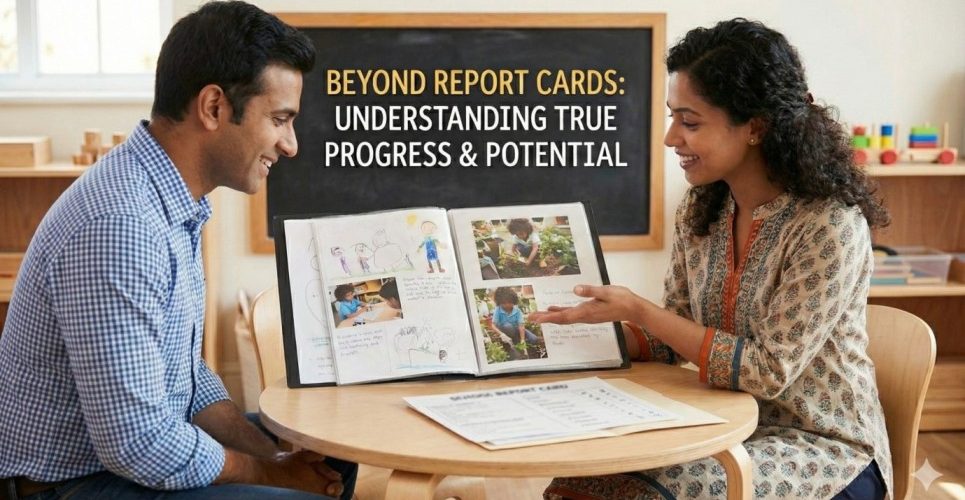
At Mentor International School, a leading CBSE school in Hadapsar, Pune, we believe that every child is more than a mark sheet. While we maintain high academic standards, we also recognize, nurture, and celebrate the diverse ways children learn, grow, and excel.
This comprehensive guide will help you:
- Understand what report cards actually measure (and what they miss)
- Recognize different types of intelligence and progress
- Respond to grades in ways that motivate rather than discourage
- Support your child’s complete development
- See your child’s true potential beyond numbers
Part 1: What Report Cards Actually Measure (And Their Limitations)
Report cards primarily measure:
1. Academic Knowledge at One Point in Time
Tests capture what a child knows on a particular day. One bad day, anxiety, or lack of sleep can significantly impact results.
2. Certain Types of Intelligence
Traditional exams favor:
- Linguistic intelligence (reading, writing, verbal skills)
- Logical-mathematical intelligence (problem-solving, calculations)
They often undervalue:
- Spatial intelligence (design, art, visualization)
- Musical intelligence
- Bodily-kinesthetic intelligence (sports, dance, hands-on skills)
- Interpersonal intelligence (social skills, leadership)
- Intrapersonal intelligence (self-awareness, emotional regulation)
- Naturalist intelligence (understanding nature, patterns)
3. Performance Under Pressure
Exams measure how well a child performs in a timed, high-pressure environment—not their actual depth of understanding or ability to apply knowledge in real life.
1. Growth and Improvement
A student who moves from 45% to 65% has shown more progress than one who stays at 85%. But report cards only show the final number, not the journey.
2. Effort and Persistence
Two students might both score 75%, but one barely studied while the other worked incredibly hard. Grades don’t distinguish effort.
3. Creative and Critical Thinking
Most exams reward “correct answers,” not original thinking, questioning, or creativity.
4. Character and Values
Kindness, integrity, resilience, empathy, leadership—none of these appear on report cards, yet they predict life success more than grades do.
5. Practical Application
A child might score 90% on a science test by memorizing but struggle to apply that knowledge to solve real-world problems.
6. Social and Emotional Skills
How well does your child collaborate? Manage emotions? Resolve conflicts? Navigate friendships? These critical life skills aren’t graded.
Part 2: The Multiple Intelligences Framework – Every Child is Smart in Their Own Way
Psychologist Dr. Howard Gardner revolutionized education by proposing that intelligence is not singular—it’s multiple.
1. Linguistic Intelligence (Word Smart)
Strengths: Reading, writing, storytelling, debating, languages
How they learn best: Through words, books, discussions, writing
Career paths: Writers, journalists, lawyers, teachers, poets
2. Logical-Mathematical Intelligence (Number/Logic Smart)
Strengths: Problem-solving, reasoning, patterns, calculations, scientific thinking
How they learn best: Through logic, patterns, experiments, puzzles
Career paths: Scientists, engineers, mathematicians, analysts, programmers
3. Spatial Intelligence (Picture Smart)
Strengths: Visualizing, drawing, design, navigation, understanding maps and diagrams
How they learn best: Through images, colors, diagrams, videos, building models
Career paths: Architects, artists, designers, surgeons, pilots
4. Musical Intelligence (Music Smart)
Strengths: Rhythm, melody, pitch, tone, composing, performing
How they learn best: Through music, rhythm, sound, singing
Career paths: Musicians, composers, sound engineers, music therapists
5. Bodily-Kinesthetic Intelligence (Body Smart)
Strengths: Physical coordination, sports, dance, hands-on creation, acting
How they learn best: Through movement, touch, doing, building
Career paths: Athletes, dancers, surgeons, craftspeople, actors
6. Interpersonal Intelligence (People Smart)
Strengths: Understanding others, communication, empathy, leadership, collaboration
How they learn best: Through group work, discussions, teaching others
Career paths: Teachers, counselors, salespeople, HR professionals, politicians
7. Intrapersonal Intelligence (Self Smart)
Strengths: Self-awareness, reflection, goal-setting, emotional regulation, independence
How they learn best: Through independent study, reflection, journaling
Career paths: Psychologists, philosophers, researchers, entrepreneurs, writers
8. Naturalist Intelligence (Nature Smart)
Strengths: Understanding nature, categorizing, observing patterns in natural world
How they learn best: Through nature exploration, categorizing, hands-on environmental work
Career paths: Biologists, environmentalists, veterinarians, botanists, farmers
Why This Matters for Your Child
Traditional schools primarily test #1 (Linguistic) and #2 (Logical-Mathematical).
If your child excels in these, they’ll likely score well on report cards.
But what if your child is:
- A brilliant artist who struggles with math?
- A natural athlete who finds reading difficult?
- A compassionate leader who performs average academically?
- A creative musician who doesn’t test well?
They are still intelligent—just in different ways.
Your job as a parent is to recognize and nurture their unique intelligences, not just the two that schools typically measure.
Part 3: How to Read a Report Card Meaningfully (Beyond the Numbers)
When you receive your child’s report card, try this approach:
Step 1: Look for Patterns, Not Just Individual Marks
Ask:
- Which subjects consistently strong or weak?
- Are there patterns across subjects (e.g., strong in practical, weak in theory)?
- Has there been improvement or decline from last term?
Why: Patterns reveal more than isolated numbers.
Step 2: Consider Teacher Comments Carefully
Teachers often write brief comments like:
- “Needs to pay more attention in class”
- “Shows excellent creativity”
- “Struggles with time management”
These comments often reveal more than marks do.
Questions to ask the teacher:
- “What specific behaviors did you observe?”
- “Can you give me an example?”
- “What can we do together to support improvement?”
Step 3: Compare Your Child to Themselves, Not Others
Instead of: “Sharma ji’s son got 95%. Why did you get 75%?”
Try: “Last term you scored 68%, now 75%. That’s 7% growth! What helped you improve?”
Why: Personal growth is what matters. Every child has a different starting point and pace.
Step 4: Identify Strengths to Build On
Look for:
- Subjects where they scored well
- Teacher comments about effort, participation, creativity
- Areas where they improved
Celebrate these first before discussing weaknesses.
Why: Confidence built on strengths motivates children to tackle weaknesses.
Step 5: Understand the “Why” Behind Low Marks
Low marks can mean many things:
- Didn’t understand the concept
- Didn’t study enough
- Test anxiety
- Teaching style didn’t match learning style
- Personal challenges (health, family stress, peer issues)
Instead of assuming laziness, investigate with curiosity:
“Let’s figure out together why this was challenging. What made it hard?”
Part 4: The Growth Mindset Conversation – How to Respond to Any Report Card
Your response to your child’s report card shapes their self-image and motivation.
Fixed Mindset Response (Harmful):
“You’re so smart! I’m so proud!”
Why it’s harmful:
Praises innate ability (“smart”), making the child fear future failure (which would prove they’re not smart after all).
Growth Mindset Response (Helpful):
“I can see you worked really hard this term. Your effort in studying every day and asking questions paid off. I’m proud of how you approached learning.”
Why it works:
Celebrates effort and strategy, reinforcing that success comes from actions they control.
Scenario 2: Average/Mixed Grades
Fixed Mindset Response (Harmful):
“You could do better if you just tried harder. You’re capable of more.”
Why it’s harmful:
Creates guilt without specific guidance. “Try harder” is vague and discouraging.
Growth Mindset Response (Helpful):
“I see you did well in English and Social Studies. What strategies worked there? Let’s apply those to Math and Science. What do you think would help?”
Why it works:
Acknowledges strengths, encourages reflection, invites problem-solving together.
Fixed Mindset Response (Harmful):
“You failed again? Maybe you’re just not good at Math. Maybe you should focus on subjects you’re better at.”
Why it’s harmful:
Confirms failure as permanent identity. Encourages giving up.
Growth Mindset Response (Helpful):
“These marks show there’s room for growth. Let’s figure out what happened. Did you understand the concepts? Did you need more help? Let’s make a plan together for next term.”
Why it works:
Frames failure as temporary and solvable. Focuses on future action, not past shame.
Part 5: The Mentor International School Approach – Whole Child Assessment
At Mentor International School, we assess students across multiple dimensions:
1. Academic Progress (Beyond Just Marks)
We evaluate:
- Conceptual understanding (not just memorization)
- Growth from baseline (how much has the student improved?)
- Application skills (can they use knowledge in new situations?)
- Critical thinking (do they ask good questions?)
2. Social-Emotional Development
We assess:
- Collaboration: How well do they work in groups?
- Communication: Can they express ideas clearly?
- Empathy: Do they show kindness and understanding?
- Self-regulation: Can they manage emotions and behavior?
3. Creative and Practical Skills
We recognize:
- Artistic expression (art, music, drama)
- Physical abilities (sports, coordination, fitness)
- Innovation (problem-solving, design thinking)
- Leadership (initiative, responsibility, peer influence)
We observe:
- Integrity: Honesty, fairness, ethical behavior
- Responsibility: Completing tasks, being accountable
- Resilience: Bouncing back from setbacks
- Curiosity: Love of learning, asking questions
Our Comprehensive Report Card Includes:
- Subject-wise academic marks
- Teacher observations (effort, participation, behavior)
- Social-emotional skill ratings
- Co-curricular achievements (sports, arts, clubs)
- Areas of strength highlighted
- Specific, actionable suggestions for growth
- Space for student self-reflection
Parents receive not just numbers, but a complete picture of their child’s development.
Part 6: Supporting Different Types of Learners at Home
Once you understand your child’s unique intelligence profile, you can support them more effectively:
- Read together daily
- Encourage journaling
- Play word games
- Discuss current events
- Let them explain concepts to you verbally
For Logical-Mathematical Learners:
- Provide puzzles and brain teasers
- Explore coding and robotics
- Discuss “how things work”
- Encourage strategy games (chess, Sudoku)
- Connect math to real life (cooking measurements, money)
- Provide art supplies
- Use diagrams and mind maps for studying
- Encourage building (Lego, models)
- Explore maps and architecture
- Let them draw concepts instead of just writing
- Allow background music while studying (if it helps focus)
- Encourage instrument learning
- Create songs or rhymes for memorization
- Attend concerts together
- Notice rhythm and patterns in language
For Bodily-Kinesthetic Learners:
- Allow movement while learning (walking, standing desk)
- Use hands-on experiments
- Encourage sports and dance
- Build models, conduct experiments
- Take frequent movement breaks
- Arrange study groups
- Let them teach siblings or friends
- Discuss moral dilemmas together
- Encourage participation in group activities
- Value their social awareness
- Provide quiet, independent study time
- Encourage journaling and reflection
- Respect their need for alone time
- Ask them to set personal goals
- Value their self-awareness
- Spend time outdoors
- Visit museums, zoos, gardens
- Encourage collection and categorization (rocks, leaves)
- Connect lessons to nature
- Support environmental projects
Part 7: The Long View – What Really Predicts Success in Life?
Research on long-term life outcomes reveals surprising truths:
Academic Grades Are Weak Predictors of:
- Career success
- Life satisfaction
- Relationship quality
- Mental and physical health
Stronger Predictors of Success:
- Emotional intelligence
- Grit and perseverance
- Growth mindset
- Social skills
- Creativity and adaptability
- Integrity and ethics
- Curiosity and love of learning
The student who scores 75% but is resilient, curious, empathetic, and hardworking will often outperform the 95% scorer who lacks these qualities.
Conclusion: See Your Child, Not Just Their Marks
Every child is on their own unique journey. Some bloom early. Some bloom late. Some bloom in ways report cards can’t measure.
Your child is not a percentage. They are:
- A learner discovering the world
- A friend navigating relationships
- A creative mind exploring possibilities
- A person developing character and values
- A unique individual with gifts the world needs
At Mentor International School, we see every child in their fullness.
We celebrate the scientist and the artist, the athlete and the musician, the quiet thinker and the charismatic leader.
We invite you to visit our campus in Hadapsar, Pune.
See assessment that goes beyond marks.
Meet teachers who know students deeply.
Experience an environment where every child’s unique intelligence is recognized and nurtured.
Because every child deserves to be seen for who they truly are—not just what they score.
Contact Us:
Mentor International School
Hadapsar, Pune
Schedule a Visit and discover education that values the whole child.
