

Personalized Learning: Simple Tips to Study in the Way That Works Best for You
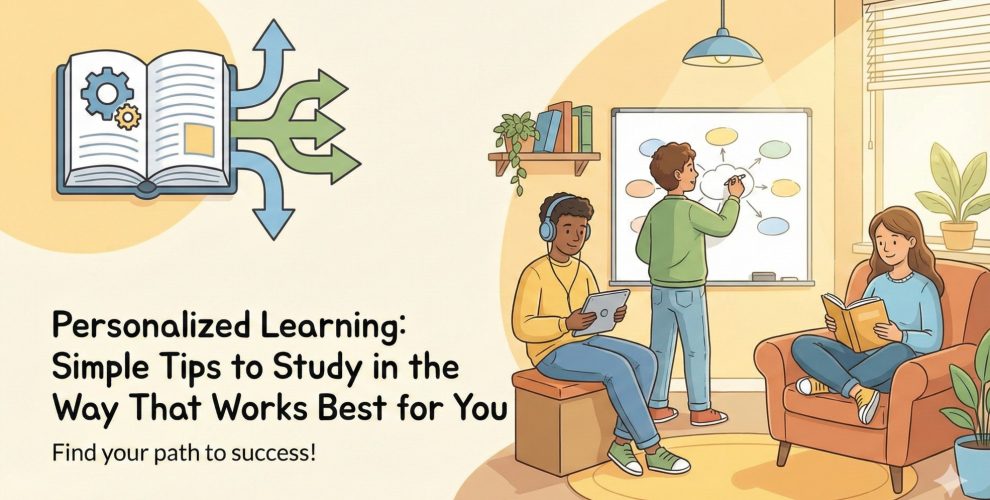
Personalized Learning: Simple Tips to Study in the Way That Works Best for You
Introduction: One-Size-Fits-All Doesn’t Work
Every class has that student who tops every exam, the one who understands everything from just one explanation. If you’ve ever wondered, “Why doesn’t that work for me?”—you’re asking the right question.
Because learning is personal.
You have your own pace, your own strengths, your own struggles. Personalized learning is about designing your study style around you, instead of trying to force yourself into someone else’s routine.
Below are practical, student-friendly tips to help you build a personalized learning system that actually fits your brain and your life.
1. Know Your Learning Preferences (But Don’t Get Stuck in Labels)
You don’t have to call yourself “visual” or “auditory” forever, but you should notice what helps you remember best.
Ask yourself:
- Do I remember better when I see things (diagrams, charts, colours)?
- Do I remember better when I hear explanations (teacher, videos, podcasts)?
- Do I remember better when I do something (writing, solving, teaching, making)?
- Visual: Use mind maps, colour-coded notes, diagrams, timelines.
- Auditory: Record your own explanations, talk concepts out loud, teach a friend, use YouTube explanations.
- Kinesthetic: Write lots, move while revising (walk and recite), do more practice problems than reading.
Don’t limit yourself to one style—combine 2–3 in a way that feels natural.
2. Set Personal Goals, Not Just Marks
Marks are outcomes, not plans. Personalized learning starts with clear, realistic goals.
- Long-term: “I want 85%+ overall this year.”
- Subject-wise: “I want to move from 50 to 70 in Maths by next term.”
- Skill-based: “I want to get better at writing long answers in Science.”
Now break them into weekly mini-goals:
- “This week I will master linear equations.”
- “This week I will learn 5 new English vocabulary words per day.”
- “This week I will finish 2 chapters of History revision.”
Personalized learning = your goals, your pace, your path.
3. Design Your Own Study Routine (Not a Copy-Paste Timetable)
Copying toppers’ timetables rarely works. Your energy levels, tuition timings, commute, and family environment are different.
Step 1: Notice your high-energy time
- Morning person? Do tough subjects early (Maths, Physics).
- Night person? Keep harder topics for evenings, lighter revision earlier.
Step 2: Use “blocks” instead of strict minutes
Plan in 40–50 minute blocks with 10-minute breaks:
- Block 1: New learning (watch lecture/read chapter).
- Block 2: Practice (questions, examples, flashcards).
- Block 3: Active recall (self-test without notes).
Have a core routine (anchors like “6–7 PM = study every day”), but allow yourself to switch subjects based on school load and mood.
4. Use Active Learning, Not Passive Reading
Personalized learning is not about how long you sit; it’s about what you do when you sit.
Passive:
- Just reading.
- Just listening.
- Just highlighting.
Active:
- Summarizing in your own words.
- Teaching a chapter to an imaginary class.
- Solving problems without looking at the solution.
- Making questions and then answering them.
Try this 3-step method for any topic:
- Learn: Read/watch once with full focus.
- Close the book: Write a quick summary or key points from memory.
- Check: Open the book and see what you missed, then improve your notes.
This is personalized because your notes will reflect your understanding and your gaps.
5. Build Your Own System for Weak Subjects
Instead of saying “I’m bad at Maths/Science/English,” treat it like a project.
Ask:
- Is it basic concepts? (e.g., tables, fractions, grammar rules)
- Is it speed? (not enough practice)
- Is it fear/anxiety?
For example, for Maths:
- 10–15 minutes daily of only basics (tables, formulas).
- 3 days/week: easy to moderate questions from textbook.
- 1 day/week: past papers or mixed questions.
For English:
- Daily: Read 1 page of any book/newspaper.
- 3–5 new words/day in a small notebook.
- Weekly: Write 1 paragraph or essay and self-correct.
Your weak subject needs small, frequent, personalized doses, not random panic studying before exams.
6. Use Spaced Repetition and Personal Revision Cycles
Your brain forgets. That’s normal. The trick is to revisit at the right times.
Simple revision cycle you can personalize:
For any new topic, revise:
- Day 1: Learn it.
- Day 2: Quick 10-minute review + 3–5 questions.
- Day 4: Self-test without looking.
- Day 7: Solve exam-style questions.
- Before exam: One more short revision.
You can keep a “Revision Tracker” page:
- List chapter name + dates you revised.
- Tick off each revision cycle.
Personalization = you adjust how often you need to revisit based on how hard that topic feels for you.
7. Create Your Own Tools: Notes, Flashcards, and Cheat Sheets
The best notes are not the neatest—they are the most useful to your brain.
- Concept maps: One page showing relations between ideas (great for Science, Social Studies).
- Formula sheets: All formulas in one place, grouped by chapter.
- Flashcards: Question on one side, answer on the other (great for definitions, dates, terms).
- Mistake book: A small notebook where you only write mistakes, wrong answers, and confusing points—with corrected explanations.
Don’t waste time making “pretty” notes for Instagram. Make ugly but powerful notes that help you score marks.
8. Adjust Study Style to Subject Type
Personalization also means not using the same approach for every subject.
For Maths / Physics / Accountancy:
- 80% practice, 20% reading.
- Solve questions step-by-step.
- After each chapter: timed practice to improve speed.
For Biology / History / Geography:
- Break into chunks.
- Use diagrams, timelines, flowcharts.
- Teach someone else or explain aloud from memory.
For Languages (English, Hindi, etc.):
- Read daily (stories, articles, essays).
- Practice writing (answers, letters, essays).
- Learn grammar by using it in sentences, not just memorizing rules.
9. Track Yourself and Reflect Weekly
Once a week (Sunday works well), spend 10–15 minutes on self-review:
Ask:
- What went well this week?
- Which subject improved?
- Where did I waste time?
- What change can I try next week? (1 small change only)
You can keep a “Learning Journal” with short entries:
“This week: Finished 2 chapters in Science, still stuck in Algebra. Next week: 15 mins daily only for Algebra basics.”
This reflection is what turns random studying into personal growth.
10. Protect Your Energy: Sleep, Breaks, and Screens
Personalized learning fails if your brain is exhausted.
- Aim for 7–9 hours (depending on your age).
- Late-night cramming = short-term memory, more mistakes, low next-day focus.
Use the 50–10 or 25–5 rule:
- 50 minutes study → 10 minutes break
or - 25 minutes study → 5 minutes break (Pomodoro style)
Use breaks to:
- Stretch
- Drink water
- Walk
Not to scroll endlessly.
- Decide when you’ll use social media, not “whenever I feel like.”
- During study blocks: Phone out of reach or in another room.
- Use tech for learning (videos, apps, quizzes), not against yourself.
11. Ask for Support in a Way That Fits You
Personalization does not mean doing everything alone.
You can:
- Ask a teacher: “Can you give me 2–3 extra questions for practice?”
- Form a small study group with 1–3 serious friends (not a gossip club).
- Tell your parents what you need: “Please remind me at 6 PM to start,” or “I need a quiet place for 1 hour.”
Support becomes powerful when you clearly know and communicate what helps you.
12. Start Small: Personalization in 3 Simple Steps
If you feel overwhelmed, do just these three things this week:
- Pick one weak subject.
Decide one tiny daily action (10–15 minutes) for it. - Change how you revise one chapter.
Instead of re-reading, try: read → close book → write from memory → check. - Do a 10-minute weekly reflection.
Write: “This week in my studies: … Next week I will: …”
That alone will start moving you from random studying to personalized learning.
Final Thoughts: You Are Not “Bad at Studying”—You Just Need Your Own System
If school or tuition has ever made you feel like you’re “slow,” “lazy,” or “not smart enough,” remember this:
Most students are not failing subjects. They are failing systems that were never designed for them.
Personalized learning is you taking back control:
- Learning in ways that make sense to you.
- At a pace that challenges but doesn’t crush you.
- With tools you designed yourself.
If you want, tell me:
- Your class/grade
- Your strongest and weakest subjects
- How you currently study
I can help you design a short, personalized weekly study plan just for you.
