

Public Speaking and Confidence: Why Communication is the #1 Skill for the Future
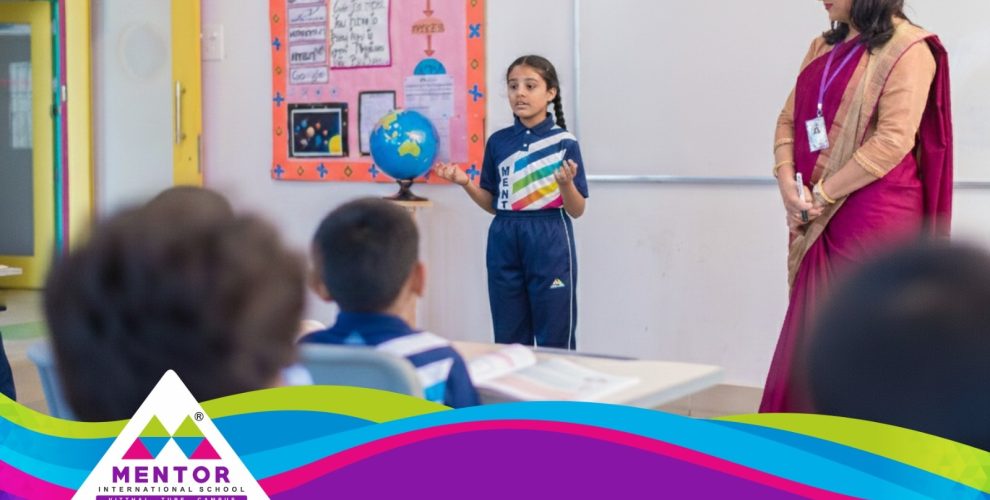
In a world dominated by screens, text messages, and emails, the art of face-to-face communication often feels like it is fading. Yet, paradoxically, the ability to speak clearly, confidently, and persuasively has never been more valuable.
We often hear about the importance of coding, mathematics, and science—and these are indeed critical. But ask any CEO, entrepreneur, or HR manager what the rarest and most sought-after skill is, and the answer is almost always the same: Communication.
At Mentor International School, a top CBSE school in Hadapsar, we believe that education is incomplete if a student has brilliant ideas but lacks the confidence to share them. We are not just raising scholars; we are raising leaders. And leaders need a voice.
In this blog, we explore why public speaking is the ultimate “future-proof” skill and how we cultivate it within our classrooms.
The “Soft Skill” That is Actually a “Hard Power”
For decades, public speaking was viewed as a “soft skill”—a nice-to-have bonus, like good handwriting. Today, that narrative has flipped. In the 21st-century economy, communication is a hard power.
Why? Because automation and Artificial Intelligence (AI) are rapidly taking over routine tasks. Algorithms can analyze data faster than any human. Robots can assemble cars with perfect precision. But what can AI not do?
It cannot inspire a team during a crisis. It cannot negotiate a delicate peace treaty. It cannot pitch a visionary startup idea to investors with passion.
Confidence and communication are the uniquely human advantages.
Whether your child grows up to be a doctor explaining a diagnosis to a patient, an engineer pitching a new design, or a teacher inspiring the next generation, their success will hinge on their ability to connect with others.
5 Reasons Why Public Speaking Matters for Students
1. It Builds True Confidence (Not Just Arrogance)
There is a profound difference between arrogance and confidence. Arrogance screams; confidence whispers. Public speaking teaches students to be comfortable in their own skin. Standing on a stage (or even at the front of a classroom) is vulnerable. Overcoming the fear of “all eyes on me” builds a deep, inner resilience. When a child realizes, “I can speak, and people will listen,” their self-esteem skyrockets in every other area of life.
2. It Sharpens Critical Thinking
You cannot speak clearly if you do not think clearly. To give a good speech or debate a point, a student must organize their thoughts, structure their arguments, and anticipate counter-arguments. This process forces them to analyze information critically rather than just memorizing it. Writing a speech is essentially an exercise in logic and persuasion.
3. It Enhances Academic Performance
Communication skills translate directly to better grades. Students who are confident speakers are more likely to participate in class discussions, ask questions when they are confused, and lead group projects. They excel in oral exams and interviews. Moreover, the research skills required to prepare for a speech reinforce their learning in subjects like History, Social Studies, and Science.
4. It Prepares Them for the Professional World
According to the National Association of Colleges and Employers (NACE), verbal communication skills are consistently ranked as the #1 candidate quality by employers. In a job interview, your degree gets you in the door, but your communication skills get you the job. In the boardroom, the person who can articulate the best strategy is often the one who leads the project.
We want our children to be good citizens who stand up for what is right. Public speaking is the tool of change-makers. From Greta Thunberg to Malala Yousafzai, young people are changing the world with their voices. By teaching students how to advocate for themselves and others, we give them the power to make a difference in their communities.
How Mentor International School Builds Confident Speakers
Many people believe that public speaking is a natural talent—you are either born with it, or you aren’t. At Mentor International School, we fundamentally disagree. Public speaking is a muscle. It can be trained, strengthened, and developed.
We don’t just have an annual “Speech Day” and call it done. We integrate communication training into the daily fabric of our school culture. Here is how:
1. The “Stage for Everyone” Philosophy
In many schools, only the extroverts or the class toppers get the microphone. We ensure every child gets a turn. From “Show and Tell” in our primary years to formal presentations in secondary school, we create low-stakes opportunities for students to speak. This normalizes the experience. When speaking in front of a group is a regular Tuesday activity rather than a once-a-year terror, the fear evaporates.
2. Structured Debates and MUN (Model United Nations)
For our older students, we offer rigorous platforms like Debating Clubs and Model United Nations (MUN). These are not just about speaking; they are about listening, researching, and negotiating.
- Debates teach students to see multiple sides of an issue. They learn to attack the argument, not the person—a crucial life skill in today’s polarized world.
- MUN simulates global diplomacy. Students represent different countries and solve global crises. It teaches them formal, diplomatic language and the art of compromise.
We encourage student-led assemblies and clubs. Instead of teachers always making the announcements, our Student Council and house captains take the lead. They learn to write scripts, manage time, and hold the attention of hundreds of their peers. This peer-to-peer communication is often more powerful than teacher-student instruction.
4. Language Labs and Literary Events
As a top CBSE school, we place a strong emphasis on language mastery. Our language labs focus on pronunciation, vocabulary, and intonation. We host regular literary events—poetry recitations, storytelling sessions, and dramatic readings—that celebrate the beauty of spoken language. We believe that words should be tasted and savored, not just written on a page.
5. Constructive Feedback, Not Criticism
The fear of public speaking is usually the fear of judgment. Our teachers are trained to give feedback that empowers. Instead of saying, “You looked nervous,” we might say, “Your opening hook was excellent; next time, try making eye contact with the back row to draw them in.” We celebrate the effort, not just the outcome.
Tips for Parents: Cultivating Confidence at Home
School is only half the equation. You, as parents, play a vital role in helping your child find their voice. Here are three simple things you can do at home:
- The “Dinner Table Debate”: Use family meals to discuss current events or fun topics (e.g., “Is cricket better than football?”). Encourage your child to give a reason for their opinion. Listen without interrupting. This validates that their opinion matters.
- Order for Themselves: When you go to a restaurant, let your child order their own meal. It sounds small, but speaking to an adult stranger in a safe environment is a great confidence booster for younger children.
- Read Aloud Together: Even for older children, reading a book script or a play aloud can be fun. Experiment with different voices for different characters to make them comfortable with vocal expression.
Conclusion: The Voice of the Future
At the end of the day, we don’t know exactly what the world of 2040 will look like. We don’t know what new technologies will exist or what political challenges will arise. But we do know this: the world will always need people who can stand up, speak the truth, and inspire others to action.
At Mentor International School, we are committed to ensuring that your child is one of those people. We are nurturing a generation that is not only “tech-savvy” but also “people-savvy.”
When you choose Mentor International School, you are choosing a school that values your child’s voice. Because we know that inside every quiet student is a leader waiting to be heard.
Let’s help them find their voice.
To learn more about our co-curricular activities, debate clubs, and how we foster holistic development, visit our campus in Hadapsar, Pune. Admissions open for the upcoming academic session.
Public Speaking and Confidence: Why Communication is the #1 Skill for the Future Blog 2 Second Week December
In a world dominated by screens, text messages, and emails, the art of face-to-face communication often feels like it is fading. Yet, paradoxically, the ability to speak clearly, confidently, and persuasively has never been more valuable.
We often hear about the importance of coding, mathematics, and science—and these are indeed critical. But ask any CEO, entrepreneur, or HR manager what the rarest and most sought-after skill is, and the answer is almost always the same: Communication.
At Mentor International School, a top CBSE school in Hadapsar, we believe that education is incomplete if a student has brilliant ideas but lacks the confidence to share them. We are not just raising scholars; we are raising leaders. And leaders need a voice.
In this blog, we explore why public speaking is the ultimate “future-proof” skill and how we cultivate it within our classrooms.
The “Soft Skill” That is Actually a “Hard Power”
For decades, public speaking was viewed as a “soft skill”—a nice-to-have bonus, like good handwriting. Today, that narrative has flipped. In the 21st-century economy, communication is a hard power.
Why? Because automation and Artificial Intelligence (AI) are rapidly taking over routine tasks. Algorithms can analyze data faster than any human. Robots can assemble cars with perfect precision. But what can AI not do?
It cannot inspire a team during a crisis. It cannot negotiate a delicate peace treaty. It cannot pitch a visionary startup idea to investors with passion.
Confidence and communication are the uniquely human advantages.
Whether your child grows up to be a doctor explaining a diagnosis to a patient, an engineer pitching a new design, or a teacher inspiring the next generation, their success will hinge on their ability to connect with others.
5 Reasons Why Public Speaking Matters for Students
1. It Builds True Confidence (Not Just Arrogance)
There is a profound difference between arrogance and confidence. Arrogance screams; confidence whispers. Public speaking teaches students to be comfortable in their own skin. Standing on a stage (or even at the front of a classroom) is vulnerable. Overcoming the fear of “all eyes on me” builds a deep, inner resilience. When a child realizes, “I can speak, and people will listen,” their self-esteem skyrockets in every other area of life.
2. It Sharpens Critical Thinking
You cannot speak clearly if you do not think clearly. To give a good speech or debate a point, a student must organize their thoughts, structure their arguments, and anticipate counter-arguments. This process forces them to analyze information critically rather than just memorizing it. Writing a speech is essentially an exercise in logic and persuasion.
3. It Enhances Academic Performance
Communication skills translate directly to better grades. Students who are confident speakers are more likely to participate in class discussions, ask questions when they are confused, and lead group projects. They excel in oral exams and interviews. Moreover, the research skills required to prepare for a speech reinforce their learning in subjects like History, Social Studies, and Science.
4. It Prepares Them for the Professional World
According to the National Association of Colleges and Employers (NACE), verbal communication skills are consistently ranked as the #1 candidate quality by employers. In a job interview, your degree gets you in the door, but your communication skills get you the job. In the boardroom, the person who can articulate the best strategy is often the one who leads the project.
We want our children to be good citizens who stand up for what is right. Public speaking is the tool of change-makers. From Greta Thunberg to Malala Yousafzai, young people are changing the world with their voices. By teaching students how to advocate for themselves and others, we give them the power to make a difference in their communities.
How Mentor International School Builds Confident Speakers
Many people believe that public speaking is a natural talent—you are either born with it, or you aren’t. At Mentor International School, we fundamentally disagree. Public speaking is a muscle. It can be trained, strengthened, and developed.
We don’t just have an annual “Speech Day” and call it done. We integrate communication training into the daily fabric of our school culture. Here is how:
1. The “Stage for Everyone” Philosophy
In many schools, only the extroverts or the class toppers get the microphone. We ensure every child gets a turn. From “Show and Tell” in our primary years to formal presentations in secondary school, we create low-stakes opportunities for students to speak. This normalizes the experience. When speaking in front of a group is a regular Tuesday activity rather than a once-a-year terror, the fear evaporates.
2. Structured Debates and MUN (Model United Nations)
For our older students, we offer rigorous platforms like Debating Clubs and Model United Nations (MUN). These are not just about speaking; they are about listening, researching, and negotiating.
- Debates teach students to see multiple sides of an issue. They learn to attack the argument, not the person—a crucial life skill in today’s polarized world.
- MUN simulates global diplomacy. Students represent different countries and solve global crises. It teaches them formal, diplomatic language and the art of compromise.
We encourage student-led assemblies and clubs. Instead of teachers always making the announcements, our Student Council and house captains take the lead. They learn to write scripts, manage time, and hold the attention of hundreds of their peers. This peer-to-peer communication is often more powerful than teacher-student instruction.
4. Language Labs and Literary Events
As a top CBSE school, we place a strong emphasis on language mastery. Our language labs focus on pronunciation, vocabulary, and intonation. We host regular literary events—poetry recitations, storytelling sessions, and dramatic readings—that celebrate the beauty of spoken language. We believe that words should be tasted and savored, not just written on a page.
5. Constructive Feedback, Not Criticism
The fear of public speaking is usually the fear of judgment. Our teachers are trained to give feedback that empowers. Instead of saying, “You looked nervous,” we might say, “Your opening hook was excellent; next time, try making eye contact with the back row to draw them in.” We celebrate the effort, not just the outcome.
Tips for Parents: Cultivating Confidence at Home
School is only half the equation. You, as parents, play a vital role in helping your child find their voice. Here are three simple things you can do at home:
- The “Dinner Table Debate”: Use family meals to discuss current events or fun topics (e.g., “Is cricket better than football?”). Encourage your child to give a reason for their opinion. Listen without interrupting. This validates that their opinion matters.
- Order for Themselves: When you go to a restaurant, let your child order their own meal. It sounds small, but speaking to an adult stranger in a safe environment is a great confidence booster for younger children.
- Read Aloud Together: Even for older children, reading a book script or a play aloud can be fun. Experiment with different voices for different characters to make them comfortable with vocal expression.
Conclusion: The Voice of the Future
At the end of the day, we don’t know exactly what the world of 2040 will look like. We don’t know what new technologies will exist or what political challenges will arise. But we do know this: the world will always need people who can stand up, speak the truth, and inspire others to action.
At Mentor International School, we are committed to ensuring that your child is one of those people. We are nurturing a generation that is not only “tech-savvy” but also “people-savvy.”
When you choose Mentor International School, you are choosing a school that values your child’s voice. Because we know that inside every quiet student is a leader waiting to be heard.
Let’s help them find their voice.
To learn more about our co-curricular activities, debate clubs, and how we foster holistic development, visit our campus in Hadapsar, Pune. Admissions open for the upcoming academic session.
