

The First 2000 Days: Why Early Childhood Education is the Most Critical Investment You Will Ever Make !
Introduction: The Invisible Architecture of the Brain
If you are a parent of a toddler or a preschooler, you are likely exhausted. Between the tantrums, the potty training, the endless questions of “Why?”, and the constant negotiation over vegetables, it is easy to view these early years as a phase of management. You are just trying to keep them fed, safe, and reasonably clean until “real school” begins in Grade 1.
But neuroscience tells us a different story.
The period from birth to age five—roughly the first 2000 days of life—is not a waiting room for education. It is the main event. During these years, a child’s brain is growing at an explosive rate, forming over one million new neural connections every single second. By the time a child blows out the candles on their fifth birthday cake, their brain is 90% developed.
Think about that. Ninety percent of the brain’s architecture—the foundation for all future learning, emotional regulation, and social capability—is built before they ever sit for a formal exam.
At Mentor International School, a top CBSE school in Hadapsar, we treat our Pre-Primary section not as a daycare, but as a laboratory of human potential. We understand that early childhood education (ECE) is not just about learning ABCs and 123s. It is about constructing the “hardware” of the brain that will run the “software” of advanced academics later in life.
In this deep-dive guide, we will explore the science of the developing brain, debunk common myths about preschool, and explain exactly how a structured, nurturing early years program sets your child up for a lifetime of success.
Part 1: The Science of “Serve and Return”
To understand why early education matters, we must look at how the brain builds itself. It is not genetic destiny. It is an interaction between genes and environment.
Harvard University’s Center on the Developing Child describes the primary mechanism of brain development as “Serve and Return.”
Imagine a game of tennis.
- The Serve: The child babbles, points at a bird, or cries. They are “serving” a communication to the adult.
- The Return: The adult notices and responds. “Yes, that is a blue bird! Look at it fly!” or “I see you are sad. Do you want a hug?”
This back-and-forth interaction literally builds neural pathways in the brain. When a child receives a supportive “return,” the connection in their brain is strengthened. When they are ignored (chronic neglect) or stressed (toxic stress), those connections wither or form incorrectly.
The Role of the School in “Serve and Return”
At home, you are the primary partner in this game. But as children grow, their need for interaction expands beyond what one or two parents can provide 24/7. They need new “tennis partners.”
A high-quality preschool environment provides a rich density of these interactions. At Mentor International School, our teachers are trained to be expert “returners.”
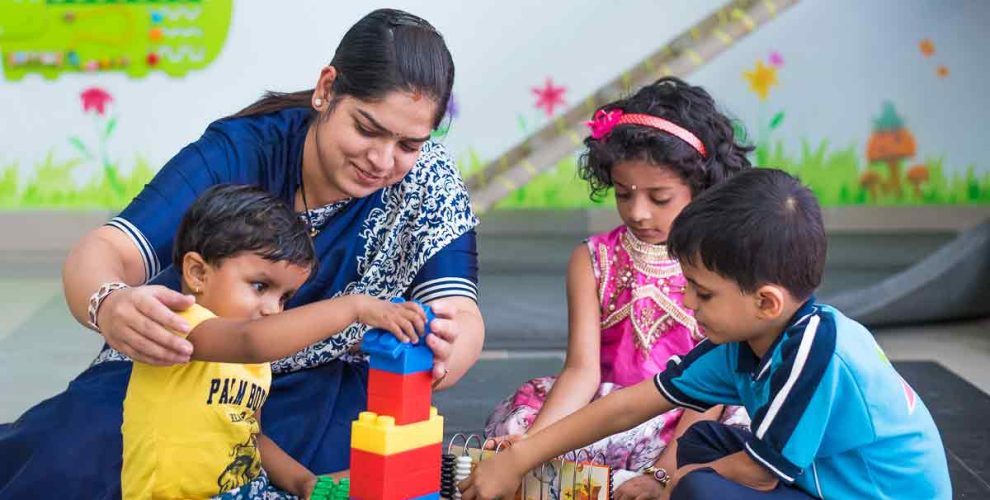
- When a child builds a tower, the teacher doesn’t just say “Good job.” They ask, “How did you balance that big block on the small one?” (This prompts critical thinking).
- When a child grabs a toy from a peer, the teacher doesn’t just say “Stop.” They say, “I see you want the truck. Ask your friend when he is finished.” (This builds social negotiation skills).
These thousands of micro-interactions every day are the bricks that build the cathedral of the mind.
Part 2: The Myth of “Just Play”
One of the most common concerns we hear from parents is: “I don’t want them to just play all day. I want them to learn.”
This statement stems from a fundamental misunderstanding of how human beings learn. For a child under six, Play IS Learning.
In the adult world, “play” is what we do when we are taking a break from work. In the child’s world, play is the work. It is the highest form of research.
Let’s look at what is actually happening when a child is “just playing” in our sandpit or block area:
- Physics and Engineering: When a child tries to build a sandcastle and it collapses, they learn about gravity, structural integrity, and material properties. They learn that wet sand holds together better than dry sand. That is physics.
- Mathematics: When they sort blocks by color or size, they are learning set theory. When they pour water from a short, fat cup into a tall, skinny cup, they are learning about volume and conservation of mass.
- Literacy: When they engage in “pretend play” (e.g., playing “House” or “Doctor”), they are creating narratives. They are assigning roles, creating a plot, and using symbolic language (using a banana as a phone). This is the precursor to reading and writing stories.
- Social Skills: You cannot play a game of tag without rules. You cannot build a fort with friends without negotiation. “You get the blankets, I will get the chairs.” Play teaches collaboration better than any lecture ever could.
At Mentor International School, our curriculum is Play-Based but Teacher-Guided. We set up the environment (the “Third Teacher”) to provoke specific learning outcomes. We don’t force a child to memorize the definition of gravity; we give them blocks and let them discover it.
Part 3: Emotional Intelligence – The Core of the Curriculum
If you ask a kindergarten teacher what the most important skill for a new student is, they won’t say “knowing the alphabet.” They will say “Self-Regulation.”
Self-Regulation is the ability to:
- Wait your turn.
- Control your impulses (not hitting when you are mad).
- Focus on a task despite distractions.
- Handle disappointment without a meltdown.
These are Executive Functions, controlled by the prefrontal cortex of the brain. Children are not born with these skills; they must be taught.
The “Toddler Tantrum” as a Teachable Moment
In a traditional view, a tantrum is “bad behavior” that needs to be punished. In our Early Years philosophy, a tantrum is an “emotional storm” that needs to be navigated.
When a 3-year-old cries because they got the blue cup instead of the red one, their brain has been hijacked by emotion. Our teachers use Social-Emotional Learning (SEL) techniques to help them wire their brains for calm.
- Labeling Emotions: “You are frustrated because you wanted the red cup.” (Name it to tame it).
- Co-Regulation: The teacher stays calm, lending their calm nervous system to the dysregulated child.
- Problem Solving: “The red cup is dirty. Would you like the blue one or the yellow one?” (Giving agency back to the child).
By age 5, a child who has been through this coaching doesn’t just “behave better.” They understand their own mind. They have higher Emotional Intelligence (EQ), which is a stronger predictor of future life success than IQ.
Part 4: Preparing for the “Big School” (Transition to Primary)
The leap from Pre-Primary to Grade 1 is significant. It is the shift from a fluid, play-based environment to a more structured, academic one. Without preparation, this transition can be traumatic, leading to “school refusal” or anxiety.
At Mentor International School, we view the Pre-Primary years as a runway for Grade 1. We ensure a smooth takeoff through a School Readiness Program.
We do not believe in drilling toddlers with worksheets. However, we do believe in immersion.
- Print-Rich Environment: Our classrooms are labeled. The door says “DOOR.” The chair says “CHAIR.” Children learn that squiggly lines on paper have meaning.
- Phonemic Awareness: Before a child can read, they must be able to hear sounds. We play rhyming games, sing songs, and clap out syllables. “Cat, Bat, Hat. What sounds the same?”
- Number Sense: We count everything. We count steps to the playground. We count apple slices at snack time. We learn that “3” isn’t just a symbol; it is a quantity.
Fine Motor Skills (The Precursor to Writing)
Parents often try to force a 3-year-old to hold a pencil. But if the child’s hand muscles are weak, this is painful and discouraging.
We focus on Fine Motor Development first.
- Threading beads requires the “pincer grasp.”
- Playing with playdough strengthens hand muscles.
- Cutting with safety scissors builds hand-eye coordination.
By the time our students reach Grade 1, their hands are strong and ready to write, and their minds are curious and ready to read. They don’t dread “work”; they see it as the next fun challenge.
Part 5: The “Digital Native” Dilemma
Today’s toddlers are “Digital Natives.” They can swipe a screen before they can turn a page. Parents are often conflicted: Should I give them the iPad to learn, or keep them away from screens entirely?
The World Health Organization (WHO) recommends zero screen time for children under 2, and limited, high-quality screen time for children aged 2-5.
At Mentor International School, our Pre-Primary classrooms are deliberately Low-Tech. We prioritize the 3D world over the 2D world.
- A screen provides passive entertainment. A block tower requires active construction.
- An app gives instant rewards (ding!). A puzzle requires patience and delayed gratification.
We are not anti-technology (we are a STEM school, after all!). But in the early years, we believe the brain needs to wire itself to the physical world first. We focus on sensory experiences—sand, water, paint, texture, music—because the brain learns through the senses, not through pixels.
Part 6: Partnering with Parents – The “Home Curriculum”
You are your child’s first and most important teacher. The best preschool in the world cannot undo the effects of a chaotic home environment. We view our relationship with parents as a Partnership.
Here are five things you can do at home to supercharge your child’s development:
1. Read Aloud Every Day
If you do only one thing, do this. Reading aloud builds vocabulary, comprehension, and bonding. It exposes children to words they won’t hear in daily conversation (like “castle,” “giraffe,” or “courage”). A child who is read to daily enters kindergarten with a “vocabulary gap” of over a million words compared to a child who is not.
2. Narrative Play
Talk to your child constantly. Narrate your day. “I am cutting the carrots. They are orange and crunchy. Now I am putting them in the pot.” This “sportscasting” floods their brain with language structure.
3. Routine is Safety
Toddlers crave predictability. They have very little control over their lives. A consistent routine (Bath, Book, Bed) reduces anxiety. It tells the brain, “I am safe; I know what comes next.”
4. Allow Boredom
Do not be the cruise director of your child’s life. If they say “I’m bored,” don’t hand them a phone. Say, “Oh? I wonder what you will invent.” Boredom is the birthplace of creativity.
5. Prioritize Sleep
A tired toddler is a dysregulated toddler. Sleep is when the brain consolidates the day’s learning. Protect their sleep schedule fiercely.
Part 7: The Mentor International School Difference
In Hadapsar’s competitive educational landscape, why should you choose Mentor International School for your little one?
We don’t dogmatically stick to one method. We curate the best practices from global philosophies:
- Montessori: For independence and practical life skills (buttoning shirts, pouring water).
- Playway: For joy, social interaction, and creativity.
- Reggio Emilia: For project-based learning and documenting the child’s journey.
- CBSE Alignment: Ensuring that the foundational skills align with the expectations of the Indian schooling system.
We know that leaving your 3-year-old with strangers is terrifying. We take that trust seriously.
- CCTV Surveillance: Our campus is monitored.
- Female Support Staff: All attendants in the pre-primary section are background-verified women.
- Child-Proofing: Rounded corners, non-toxic paints, and soft flooring in play areas.
- Hygiene: We teach and enforce strict handwashing habits, a crucial life skill in the post-pandemic world.
We track developmental milestones, yes. But our primary metric is joy.
Does the child run into school in the morning? Do they laugh? Do they feel safe to ask questions?
A happy brain is a learning brain. If a child feels loved and secure, the academics will follow naturally.
Unlike a standalone preschool, Mentor International School is a K-12 ecosystem. Your child doesn’t have to face the stress of “admissions interviews” for Grade 1. They simply move up the corridor. The teachers talk to each other. The Grade 1 teacher knows exactly what the Senior KG teacher taught. This continuity provides immense stability for the child.
Conclusion: Investing in the Foundation
When you build a house, you spend the most time and money on the foundation. You bury concrete and steel deep in the ground where no one will ever see it. But if you skip that step, the house will crack.
Early Childhood Education is the foundation of the human being.
It is easy to undervalue it because it looks like “just play.” It looks like finger painting and nursery rhymes. But underneath that surface, the most complex biological construction project in the universe is taking place.
At Mentor International School, we are the architects of that foundation. We take the potential that you send us every morning and we build a structure of curiosity, resilience, and kindness that will stand tall for the rest of their lives.
Give your child the best start.
Admissions for our Nursery, Junior KG, and Senior KG programs are open. Come visit our vibrant, colorful, and joyful campus in Hadapsar. See the magic of the first 2000 days in action.
