

The Heart of Education: Why Social-Emotional Learning (SEL) is the Missing Piece in the Modern Classroom
Introduction: The Crisis of Connection
In the last two decades, the world has become exponentially more connected digitally, yet paradoxically, more disconnected emotionally. We have algorithms that can predict our shopping habits, but we often struggle to predict or understand the feelings of the person sitting next to us.
For today’s students, this paradox is their reality. They are the most ‘connected’ generation in history, yet rates of anxiety, depression, and loneliness among adolescents are soaring globally. The pressure to perform academically is intense, amplified by the curated perfection they see on social media.
In this high-pressure environment, schools face a critical choice. Do we double down on academics, pushing for higher test scores at any cost? Or do we recognize that a child cannot learn if they are anxious, lonely, or emotionally dysregulated?
At Mentor International School, a top CBSE school in Hadapsar, we have made our choice. We believe that education must address the heart as well as the head. This approach is called Social-Emotional Learning (SEL).
It is not a ‘soft’ addition to the curriculum. It is the bedrock upon which all other learning stands. In this comprehensive guide, we will demystify SEL, explain the neuroscience behind it, and show you how it transforms not just students, but future leaders, partners, and citizens.
Part 1: What Exactly is Social-Emotional Learning?
SEL is often misunderstood. Some think it is just ‘being nice’ or ‘talking about feelings.’ While those are components, SEL is a rigorous, evidence-based framework. The Collaborative for Academic, Social, and Emotional Learning (CASEL) defines it through five core competencies:
This is the ‘Mirror.’ It is the ability to recognize one’s own emotions, thoughts, and values.
- Can I identify that I am angry before I shout?
- Do I know what my strengths and weaknesses are?
- Do I have a ‘growth mindset’ (believing I can improve)?
This is the ‘Steering Wheel.’ It is the ability to regulate one’s emotions and behaviors in different situations.
- Can I calm myself down when I am stressed?
- Can I set goals and motivate myself to achieve them?
- Can I delay gratification (work now, play later)?
This is the ‘Window.’ It is the ability to empathize with others, including those from diverse backgrounds.
- Can I understand why my friend is sad, even if I am happy?
- Can I read social cues (body language, tone of voice)?
- Do I respect others’ perspectives?
This is the ‘Bridge.’ It is the ability to establish and maintain healthy relationships.
- Can I communicate clearly?
- Can I listen actively?
- Can I resolve conflicts constructively (without fighting)?
- Can I work in a team?
5. Responsible Decision-Making
This is the ‘Compass.’ It is the ability to make ethical, constructive choices about personal behavior.
- Can I evaluate the consequences of my actions?
- Do I consider the well-being of others before I act?
When a school integrates these five pillars, it doesn’t just produce students who are ‘good at school.’ It produces human beings who are ‘good at life.’
Part 2: The Neuroscience of Emotion and Learning
Why does a school need to teach this? Shouldn’t kids just focus on Math and Science?
The answer lies in the biology of the brain. The brain is not divided into ‘thinking’ parts and ‘feeling’ parts that operate independently. They are deeply interconnected.
The Amygdala vs. The Prefrontal Cortex
The brain has an ‘alarm system’ called the Amygdala. Its job is to detect threats. When it senses danger (a tiger, a fire, or a bully), it triggers the ‘Fight, Flight, or Freeze’ response. It floods the body with cortisol and adrenaline.
The brain also has a ‘CEO’ called the Prefrontal Cortex. This is responsible for logic, reasoning, planning, and impulse control. This is the part of the brain used for solving algebra problems or writing essays.
Here is the critical insight: When the Amygdala is activated (high stress/anxiety), it effectively shuts down the Prefrontal Cortex. Neuroscientists call this an ‘Amygdala Hijack.’
If a student is bullied in the hallway, or anxious about a test, or fighting with a friend, their Amygdala is screaming ‘DANGER!’ In this state, it is biologically impossible for them to learn. You cannot do calculus when your brain thinks it is being chased by a tiger.
SEL is the tool that calms the Amygdala. It teaches students to recognize the stress response, breathe through it, and bring their Prefrontal Cortex back online. Therefore, SEL is not a distraction from academics; it is the prerequisite for academics.
Part 3: The ‘Soft Skills’ that are Actually ‘Hard Currency’
In the 20th century, you could get a job just by being smart and hardworking. In the 21st century—the age of AI and automation—those traits are the baseline, not the differentiator.
Google conducted a massive internal study called Project Aristotle to find out what made their best teams successful. They expected the answer to be ‘highest IQ’ or ‘best coding skills.’
It wasn’t.
The number one predictor of team success was Psychological Safety—a measure of social-emotional trust. Teams where members felt safe to speak up, admit mistakes, and be vulnerable outperformed teams of individual geniuses.
Similarly, the World Economic Forum lists the top skills for 2025 as:
- Analytical thinking and innovation.
- Active learning.
- Complex problem-solving.
- Critical thinking.
- Creativity, originality, and initiative.
- Leadership and social influence.
- Resilience, stress tolerance, and flexibility.
Note that almost half of these are SEL skills. Empathy, resilience, collaboration, and adaptability are the ‘hard currency’ of the future workforce. A brilliant coder who cannot work in a team is a liability. A doctor who cannot empathize with patients is ineffective.
Part 4: SEL in Action at Mentor International School
At Mentor International School, we don’t just put ‘Be Kind’ posters on the wall and call it SEL. We integrate it into the fabric of the school day. Here is what that looks like:
1. Morning Meetings / Circle Time
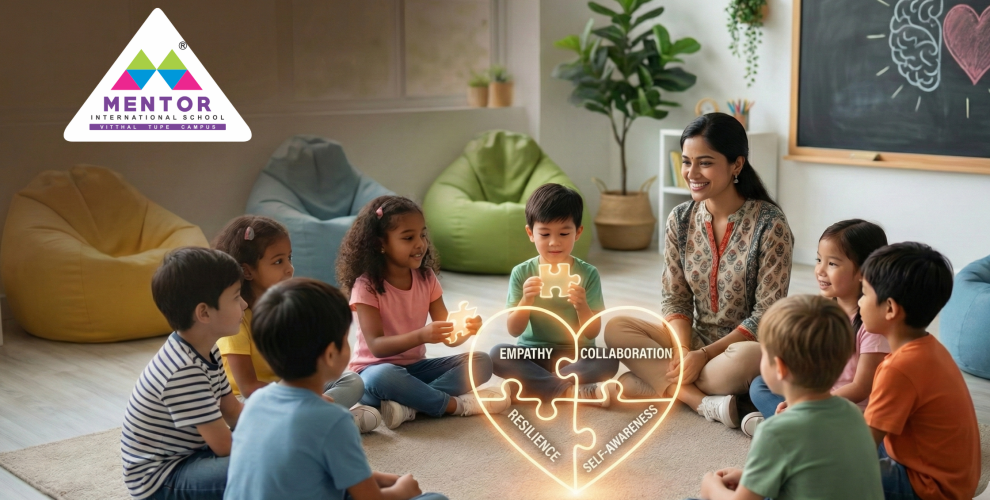
Every day begins with connection. Before opening textbooks, classes gather for a ‘Morning Meeting.’
- Greeting: Students greet each other by name, ensuring every child feels ‘seen’ before the day starts.
- Sharing: A few students share news (good or bad). This builds empathy and listening skills.
- Activity: A quick group game or challenge that builds community.
This 15-minute ritual sets the emotional tone for the day. It says: We are a community first, a class second.
We give students the vocabulary to express how they feel. A child who can say ‘I feel frustrated because the math is hard’ is very different from a child who just flips their desk.
We use tools like the Mood Meter, where students can plot their energy and pleasantness levels. This validates their feelings without judgment. ‘It’s okay to be in the Red Zone (angry); it’s not okay to hit.’
3. Conflict Resolution Protocols
Kids fight. It’s natural. Instead of the teacher just acting as a referee (‘Stop it, both of you!’), we teach students to resolve it themselves using ‘I-Statements.’
- ‘I feel… (emotion)’
- ‘When you… (action)’
- ‘Because… (reason)’
- ‘I need… (solution)’
Example: ‘I feel sad when you ignore me at recess because I have no one to play with. I need you to include me or tell me if you want space.’
This structure turns a fight into a negotiation.
4. Mindfulness and ‘Brain Breaks’
We teach biology-based regulation techniques.
- Box Breathing: Inhale 4, Hold 4, Exhale 4, Hold 4.
- Grounding: Name 5 things you see, 4 you feel, 3 you hear, 2 you smell, 1 you taste.
These are quick tools a student can use before a test or after a stressful incident to reset their nervous system.
Empathy is a muscle; it grows when used. We engage students in community service projects. Whether it is a donation drive for a local shelter or an environmental cleanup, these projects teach students to look beyond their own bubble. They learn that they have the power to impact others positively.
Part 5: The Impact on Bullying and School Culture
Bullying thrives in environments of disconnection and hierarchy. It withers in environments of empathy and community.
Research shows that schools with robust SEL programs report significantly lower rates of bullying and disciplinary issues. Why?
- Bystander Intervention: SEL teaches students to be ‘Upstanders,’ not bystanders. When they see injustice, they have the confidence and moral compass to intervene or report it.
- Empathy: It is harder to bully someone when you have listened to their story in Morning Meeting. It humanizes the ‘other.’
- Self-Regulation: Many bullies act out because they lack the skills to manage their own aggression or insecurity. SEL gives them those tools.
At Mentor International School, we aim to create a ‘No-Fear Culture.’ We want students to feel safe enough to be themselves, to make mistakes, and to be vulnerable. That safety is the fertile soil in which learning grows.
Part 6: SEL for the Digital Age
The internet is the ‘Wild West’ of social interaction. Online, people say things they would never say to someone’s face. Cyberbullying, FOMO (Fear Of Missing Out), and image crafting are constant stressors.
We extend our SEL curriculum to Digital Citizenship.
- Empathy Online: Would I say this to their face? How will they feel reading this?
- Critical Thinking: Is this photo real or filtered? Why does looking at this make me feel bad about myself?
- Impulse Control: Do I need to post this right now when I am angry?
We teach students that the rules of kindness and integrity apply just as strictly behind a screen as they do in the classroom.
Part 7: A Parent’s Guide to SEL at Home
SEL doesn’t stop at the school gate. Parents are the primary emotional coaches. Here are five ways you can reinforce these skills at home:
1. Model Vulnerability
Don’t be a robot. Let your kids see you manage emotions.
- Bad: Yelling at traffic.
- Good: Narrating your process. ‘I am feeling really frustrated with this traffic. I am going to take deep breaths so I don’t yell. Okay, that’s better.’
This shows them that emotions are normal and manageable.
2. Listen to Understand, Not to Fix
When your child comes to you with a problem (‘My friend was mean to me’), the instinct is to fix it (‘I’ll call her mom!’).
Stop. Just listen. Validate. ‘That sounds really hurtful. I can see why you are sad.’
Often, just being heard is enough to lower their stress. Then ask, ‘What do you think you want to do about it?’
3. Praise Effort, Not Traits
Instead of ‘You are so smart’ (which creates fear of failure), say ‘I love how hard you worked on that puzzle.’ This builds resilience (Self-Management).
4. The Dinner Table Check-In
Make a ritual of sharing ‘Highs and Lows’ (or ‘Rose and Thorn’) at dinner. Everyone shares one good thing and one hard thing from their day. This normalizes the fact that life is a mix of both.
5. Allow Discomfort
It is painful to watch our kids struggle. But if we swoop in to save them from every disappointment, we rob them of the chance to build resilience. Let them lose the game. Let them deal with the consequences of forgetting their homework. Be there to comfort them, but don’t prevent the lesson.
Conclusion: Raising the Whole Human
In the race for grades, degrees, and careers, it is easy to lose sight of the ultimate goal of parenting and education: to raise a good human being.
We want our children to be successful, yes. But more than that, we want them to be happy. We want them to have fulfilling relationships. We want them to be able to pick themselves up when life knocks them down. We want them to be kind.
None of these things are guaranteed by a report card. They are the fruits of Social-Emotional Learning.
At Mentor International School, we are proud to be pioneers in this holistic approach. We are not just teaching students how to make a living; we are teaching them how to make a life.
We invite you to join us in this mission. Because when we educate the heart alongside the mind, we don’t just change a classroom. We change the world.
Admissions Open.
Come visit Mentor International School in Hadapsar. Walk our halls and feel the difference. See students who look you in the eye, who hold doors for each other, and who are visibly, audibly happy to be here. That is the SEL difference.
(Keywords for SEO: Social Emotional Learning schools Pune, holistic education benefits, best CBSE school for personality development, soft skills for students, emotional intelligence in education.)
