

The Money Masters: Teaching Your Child Financial Literacy and Entrepreneurial Thinking
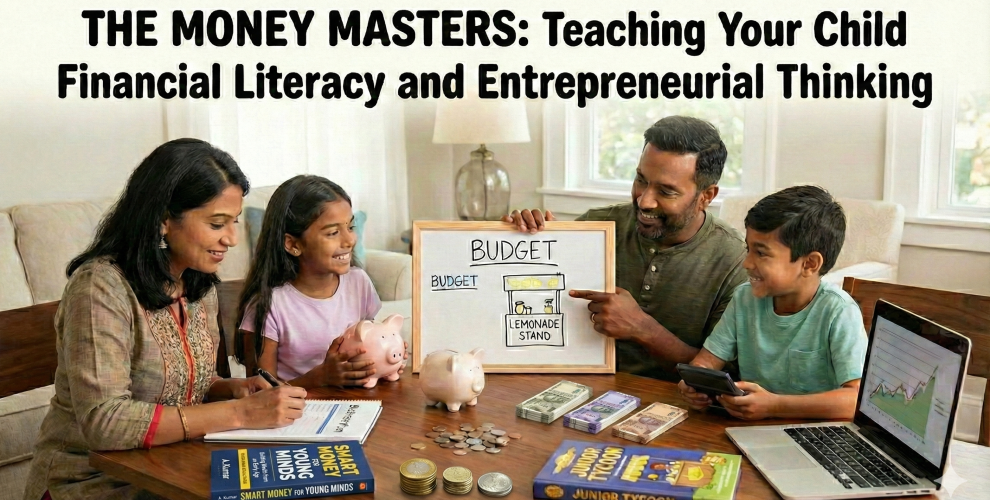
Introduction: Why Money Talks Matter Before It’s Too Late
Imagine this: Your 22-year-old child gets their first paycheck. They have no idea how to create a budget. They use credit cards without understanding interest rates. They panic when unexpected expenses arise. They make poor financial decisions that haunt them for years.
This scenario plays out millions of times globally—not because young adults are irresponsible, but because they were never taught to be responsible with money.
Here is the hard truth: Schools teach algebra but not budgeting. They teach history but not how to invest. They teach literature but not how to create financial goals. Yet, the average person will earn over $2 million in their lifetime. Without financial literacy, that wealth disappears like sand through fingers.
At Mentor International School, a top CBSE school in Hadapsar, we believe that financial literacy and entrepreneurial thinking are not optional “life skills”—they are as essential as mathematics and language. In fact, they are applied mathematics. When your child budgets, saves, and invests, they are learning real algebra with real consequences.
In this comprehensive guide, we will show you why financial education matters, how it transforms children’s thinking, and practical strategies to build money-smart, entrepreneurial kids who will thrive in an increasingly complex economic world.
Part 1: The Financial Crisis of the Young – Why This Matters Now
The Statistics Are Alarming
- 72% of Indian teenagers cannot do basic financial calculations (understanding discounts, interest, inflation)
- Average Indian household carries debt of ₹5-10 lakhs, much of it due to poor money management
- Only 24% of high school students receive any financial education
- Students who take financial literacy courses have 5.2% higher credit scores by age 25
- 90% of financial problems in adulthood stem from poor habits developed in childhood
The Cost of Ignorance
A teenager who doesn’t understand budgeting grows into an adult who:
- Overspends impulsively, accumulating credit card debt
- Cannot save for emergencies, one crisis away from disaster
- Lacks investment knowledge, missing wealth-building opportunities
- Makes poor decisions about education loans, buying homes, and retirement planning
The Consumer Financial Protection Bureau (CFPB) estimates that a person who learns financial literacy at age 20 vs. age 50 accumulates $200,000+ more wealth over their lifetime, simply through better compound interest and investment decisions.
Financial Anxiety and Mental Health
Poor financial literacy is correlated with depression, anxiety, and relationship problems. When adults feel helpless about money, it bleeds into every other life domain.
Conversely, children who grow up understanding money feel agency. They know they can earn, save, and build. This confidence extends to every other area of their lives.
Part 2: The Foundation – What Financial Literacy Actually Means
Financial literacy is not just about saving money. It is a comprehensive understanding of how money works. It includes five core competencies:
1. Understanding Money and Value Exchange
The Concept: Money is a medium of exchange. It has value because society agrees it does.
Teach It:
- Show coins and bills. What is each one worth?
- Compare: How many toys can you buy with ₹100 vs. ₹1000?
- Real-world: “Daddy works 5 hours to earn ₹500. So when you ask for a ₹500 toy, you are asking for 5 hours of Daddy’s life.”
2. Earning and Work Ethic
The Concept: Money is earned through work. There is no such thing as “free money” (except gifts and luck, which are exceptions, not the rule).
Teach It:
- Assign age-appropriate chores with compensation (not punishment-based).
- Discuss different careers and what they earn.
- Have them earn money through babysitting, tutoring, or services.
3. Spending and Decision-Making
The Concept: Every purchase is a choice. Spending money on X means NOT spending it on Y.
Teach It:
- Use the “Three Jar System”: Spending, Saving, Sharing
- Before buying, ask: “Do I need this or want this?”
- Discuss the long-term cost of small purchases (daily coffee = ₹600/month = ₹7200/year).
4. Saving and Delayed Gratification
The Concept: Sacrificing today’s pleasure for tomorrow’s security or bigger goal.
Teach It:
- Create a piggy bank or savings account. Visualize growth
- Set a savings goal (bicycle, trip, gadget). Show the progress.
- Explain compound interest: “Money grows while you sleep.”
5. Investing and Long-Term Wealth Building
The Concept: Money can work for you. Instead of just sitting in a bank, it can grow through investments.
Teach It:
- Explain stocks in simple terms: “You own a tiny piece of Amazon. If Amazon does well, your piece is worth more.”
- Use real examples: Mutual funds, gold, real estate.
- Show the power of starting early: ₹100/month from age 20 vs. ₹1000/month from age 40.
Part 3: The Entrepreneurial Mindset – Why It Matters Beyond Business
Entrepreneurship is not just about starting a business. It is a mindset—a way of thinking about problems, opportunities, and yourself.
Entrepreneurial thinkers:
- Identify problems and create solutions
- Take calculated risks instead of fearing failure
- Think creatively and outside conventional boxes
- Take ownership instead of waiting for permission
- Learn from failure instead of being paralyzed by it
- Understand value exchange: What problem am I solving? What is that worth to others?
These skills are valuable whether your child becomes an entrepreneur, employee, or leader in any field.
Why Schools Need to Teach Entrepreneurship
Traditional education teaches: Listen to the teacher. Follow the rules. Get the right answer.
Entrepreneurship teaches: Identify the problem yourself. Break the rules if they don’t make sense. Create your own solutions.
The world needs both types of thinking. But modern education over-indexes on obedience and under-indexes on initiative.
At Mentor International School, we integrate entrepreneurial thinking into the curriculum through real projects:
- Grade 5: Design a product to solve a classroom problem
- Grade 7: Create a business plan for a service business
- Grade 9: Run a micro-business (lemonade stand, tutoring, craft sales)
- Grade 11: Develop a social enterprise that solves a community problem
Part 4: Age-Appropriate Financial Education – The Roadmap
Just as children cannot learn calculus before learning addition, financial concepts build sequentially.
Ages 5-7: Foundation (Understanding Money)
Goal: Money has value. Work earns money. Money is exchanged for goods.
Activities:
- Play “Store” using coins and items
- Give small allowances for age-appropriate chores
- Let them “buy” a small toy with their own money (not parents’ money)
- Read books: “Money Moolah” series, “The Giving Tree”
Expected Outcomes:
- Understands that coins/notes have different values
- Knows that people “work” to earn money
- Can count money
- Feels ownership over “their” money
Ages 8-10: Building Blocks (Earning, Saving, Spending)
Goal: Develop earning habits, save toward goals, make conscious spending decisions.
Activities:
- The Three Jar System: Spending (immediate), Saving (goals), Sharing (charity)
- Chore Chart with Payment: Not punishment-based; clearly linked to work
- Goal Setting: “I want a bicycle. How much does it cost? How much can I save per month? When can I buy it?”
- Tracking Expenses: Simple log of what they spend money on
- Games: Monopoly teaches property, money, and consequences
Expected Outcomes:
- Saves consistently for goals
- Makes conscious (not impulsive) spending decisions
- Understands the difference between needs and wants
- Can track money for 1-2 months
Ages 11-13: Advanced Concepts (Budgeting, Value Exchange, Problem-Solving)
Goal: Create budgets, understand work value, solve real problems.
Activities:
- Family Budget Participation: Show them the family grocery/holiday budget. Let them suggest allocations
- Earn More Creatively: Tutoring younger students, selling handmade items, digital services (editing videos, graphic design)
- Micro-Business: Lemonade stand, bake sale, car wash, tutoring
- Investment Introduction: Show them a real mutual fund statement. Discuss how it grows.
- Business Plan Project: Write a simple plan for a hypothetical business
Expected Outcomes:
- Creates and maintains a personal budget
- Understands that money earned = effort invested
- Can identify a problem and brainstorm business solutions
- Manages a real business (even small) for 2-3 months
Ages 14-17: Mastery (Real Entrepreneurship, Financial Planning)
Goal: Run real businesses, understand investments, plan financial future.
Activities:
- Real Business Launch: With minimal investment, run a real business for 3-6 months
- Investment Exploration: Open a beginner’s demat account, buy 1-2 shares, track performance
- Financial Goal Setting: College fund, gadget purchase, car (future), house (future)
- Career Research: What salaries do different careers offer? Backwards-plan: “To have ₹1 crore by age 30, I need to…”
- Debt Understanding: Research credit card interest, education loans, home loans. Calculate real costs.
- Social Enterprise: Start a business that solves a social problem (not just profit-driven)
Expected Outcomes:
- Has run a profitable (or break-even) business
- Understands investments and has a basic portfolio
- Has a 5-year financial plan
- Can discuss personal finance intelligently
- Understands risk/reward and makes informed decisions
Part 5: Building Blocks of Financial Education – The Curriculum at Mentor
At Mentor International School, financial literacy is not a one-hour unit. It is integrated throughout:
In Mathematics
- Compound Interest Calculations: Real examples with real money amounts
- Percentage Applications: Discounts, taxes, interest rates
- Data Analysis: Tracking spending patterns, graphing savings growth
- Probability: Risk in investments
In Social Studies
- History of Money: How economies evolved
- Career Salaries: Researching different professions and earnings
- Economic Systems: How markets, inflation, and wages work
- Global Economics: Understanding currency exchange, international trade
In Science/Technology
- Cost-Benefit Analysis: Efficiency, resources, sustainability
- Engineering Budget: Building projects with limited funds
- Digital Finance: Cybersecurity, online banking, digital payments
In Entrepreneurship Projects
- Semester-Long Business: Plan, execute, analyze, present
- Market Research: Understanding customer needs
- Pricing Strategy: Cost + profit margin calculations
- Financial Statements: Income, expenses, profit/loss
- Pitch to Investors: Persuasive communication of business potential
Part 6: Teaching Problem-Solving and Critical Thinking (The Entrepreneurial Core)
Financial literacy without critical thinking is just rote memorization. Real financial success requires problem-solving.
The Problem-Solving Framework
Identify the Problem: What needs to be solved?
Example: “I want a phone, but I can’t afford it.”
Gather Information: What are the facts?
Example: “The phone costs ₹25,000. My allowance is ₹500/month. I can save ₹200/month.”
Brainstorm Solutions: What are ALL the options?
Example: 1. Save for 100 months; 2. Get a cheaper phone; 3. Earn more money; 4. Wait for a sale.
Evaluate Options: What are the pros/cons of each?
Example: Option 3 is best—I can tutor to earn ₹500/month, then I can afford it in 50 months.
Execute and Reflect: Try the solution. What worked? What didn’t?
Critical Thinking in Action
Instead of teaching “A credit card charges 18% interest,” ask:
- “If you spend ₹10,000 on a credit card and only pay ₹5,000 back, how much will you owe next month at 18% interest?”
- “Why do companies offer credit cards if interest rates are so high? Who wins? Who loses?”
- “Is using a credit card always bad, or are there smart ways to use it?”
These questions activate the brain differently. Students are not just absorbing—they are analyzing, evaluating, and synthesizing.
Part 7: The Real-World Impact – Stories from Mentor
Story 1: The Entrepreneurial Turnaround
Ankit was a Grade 8 student who struggled with motivation. He had no interest in academics and spent all his time on video games.
When we introduced the “Summer Entrepreneurship Project,” something clicked. He decided to start a gaming-focused YouTube channel reviewing games. Within 3 months:
- He learned video editing, photography, and audio production
- He researched keywords, analytics, and audience growth strategies (math + business)
- He turned a passion into a (small) revenue stream
- Most importantly, he developed confidence: “I can create something people want.”
Today, he is in Grade 11 with renewed academic interest. He is not planning to be a YouTuber professionally, but the entrepreneurial experience transformed his self-image from “I’m not good at anything” to “I can figure things out.”
Story 2: The Financial Goal Achiever
Priya, Grade 10, wanted an iPad. Instead of asking her parents to buy it, she created a plan:
- Researched the exact model and price (₹45,000)
- Calculated: She could save ₹2,000/month (from gifts + chores)
- Timeline: 22.5 months of patient saving
- Alternative: Could she earn extra money to accelerate?
She started tutoring younger students in Grade 8 Math. Within 12 months, she earned ₹24,000 + saved ₹24,000 = ₹48,000. She bought the iPad herself.
The iPad cost was secondary. The real learning: “I have power over my financial future. I don’t need to wait and ask. I can work toward my goals.”
Story 3: The Social Enterprise
Rohan and Zara, Grade 11, identified a problem: Single-use plastic waste in the school. They designed a project:
- Made reusable lunch containers from recycled materials
- Sold them at cost to school students (₹200 each, cost ₹150 to make)
- Used profit to plant trees
In 6 months, they:
- Sold 300 containers
- Made ₹15,000 profit
- Planted 150 trees
- Learned supply chain, marketing, customer service, social impact
They are now designing the business model to scale it to other schools.
Part 8: The Parent’s Role – What You Can Do This Week
1. Start the Allowance System
Give a weekly/monthly allowance not tied to punishment. This is their “salary,” not a reward/fine system.
- Ages 5-7: ₹50-100/week
- Ages 8-10: ₹100-200/week
- Ages 11-13: ₹200-500/month
- Ages 14+: ₹500-2000/month (can negotiate)
Critical: Let them spend it (and make mistakes) in a small sandbox.
2. Implement the Three Jar System
Spending Jar: Money to spend immediately
Saving Jar: Money for goals (birthday gifts, gadgets, etc.)
Sharing Jar: Money for charity
Divide their allowance 50%-30%-20% or let them choose the ratio.
3. Have Uncomfortable Conversations
- “How much do you think my salary is?”
- “Do you know how much your school fees are?”
- “What’s the most expensive thing in our house?”
- “If we saved ₹1000/month, what could we buy in a year?”
These conversations normalize financial discussion.
4. Let Them Work (and Earn)
Create age-appropriate paid chores:
- Ages 6-8: Feeding pets, organizing toys (₹50-100/week)
- Ages 9-11: Loading dishwasher, watering plants (₹100-200/week)
- Ages 12+: Laundry, yard work, organizing garage (₹200-500/week)
The work should be real and necessary, not busywork.
5. Make Financial Goals a Family Activity
“In our family, we are saving for a trip to Goa. Here is how much we need. Here is how much we are saving each month. Here is when we will have enough.”
Let the child help track the goal visually (thermometer on fridge, app, spreadsheet).
6. Model Good Financial Behavior
Your child watches how you spend, save, and discuss money.
- Don’t complain about being “poor” while making impulse purchases.
- Discuss financial decisions: “This shirt is on sale, but do I need it? Let me think…”
- Show your investments/savings: “I’m putting ₹5000 in a mutual fund this month. In 20 years, it will grow to…”
Part 9: The School’s Role – What to Look For
If you are choosing a school and your child is interested in entrepreneurship/financial literacy, ask:
1. Is financial literacy integrated throughout the curriculum, or just a one-unit lesson?
Answer should indicate integration across math, social studies, projects.
2. Do students run real businesses or just simulated ones?
Real businesses (even small) teach real lessons.
3. Is entrepreneurship celebrated, or only traditional academics?
Does the school recognize business wins, not just exam scores?
4. Do teachers have real business experience or academic-only?
Teachers who have run businesses bring authenticity.
5. What percentage of students start businesses while in school?
Should be high (50%+) if entrepreneurship is prioritized.
At Mentor International School, we integrate financial literacy and entrepreneurship throughout. Every student runs a business project. Every student has an allowance discussion framework with parents. Every student learns that they can create value and earn money.
Conclusion: Raising Financially Confident, Entrepreneurial Leaders
We live in an era of economic uncertainty. Jobs are automated. Careers are fluid. The “job-for-life” is extinct. Your child’s financial security will depend not on a single employer, but on their ability to create value, earn money, and manage it wisely.
Financial literacy and entrepreneurial thinking are not “nice to have.” They are survival skills.
When you teach your child to budget, save, and invest, you are not just teaching money management. You are teaching power. The power to:
- Achieve their goals independently
- Solve problems creatively
- Take risks confidently
- Build wealth over time
- Help others through financial generosity
At Mentor International School, we are committed to raising a generation of financial citizens and entrepreneurs. We don’t just teach content; we teach capability and confidence.
Your child’s financial future is not predetermined. It is designed by the habits they build today.
Come visit Mentor International School in Hadapsar. See our students running businesses, tracking investments, and dreaming big. Experience a school where financial literacy and entrepreneurship are as foundational as reading and writing.
Because the children who understand money will not just have better lives—they will have better choices.
