

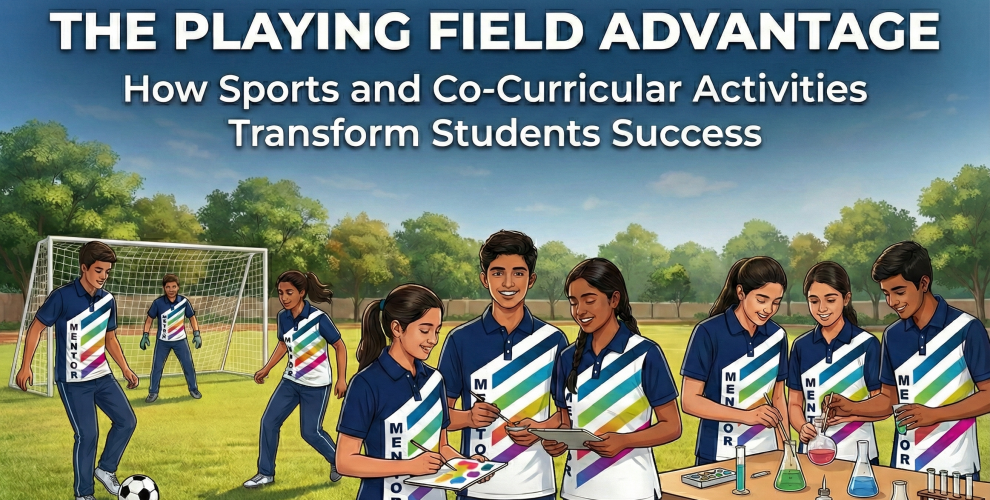
The Playing Field Advantage: How Sports and Co-Curricular Activities Transform Student Success
Introduction: The Stadium Effect
Walk into the fields of any school during sports period, and you will see something remarkable. The shy girl who barely speaks in class commands her hockey team with clarity and authority. The “average” student who struggles with algebra displays spatial intelligence and strategic thinking on the cricket pitch. The anxious boy finds confidence and belonging in his badminton club.
These transformations are not coincidental. They are the result of something that traditional academics alone cannot deliver: Physical challenge, real-time feedback, genuine failure, and communal celebration.
For decades, sports and co-curricular activities were viewed as “extras”—nice to have, but secondary to academics. A student who scored 95% in exams but wasn’t athletic was considered successful. A student who excelled in sports but averaged 70% in exams was viewed as having “wasted potential.”
This false dichotomy has created generations of academically strong but personally fragile students. They can ace a test but cannot handle rejection. They can solve equations but not navigate conflict. They are brilliant in silos but ineffective in teams.
At Mentor International School, a top CBSE school in Hadapsar, we reject this outdated paradigm. We believe that sports and co-curricular activities are not extras—they are essentials. They are the laboratories where character is forged, where resilience is built, and where students discover capabilities they never knew they had.
In this comprehensive guide, we will explore the science behind why sports and co-curricular activities are transformative, the specific benefits for different types of students, and how a school integrates these into a genuine holistic education.
Part 1: The Science – Why Sports Change the Brain and Body
Physical Benefits: More Than Fitness
The World Health Organization recommends 60 minutes of physical activity daily for children aged 5-17. Most Indian schools provide 40-45 minutes of PE per week. The gap is staggering.[1]
When a child engages in structured physical activity, multiple systems transform:
Cardiovascular System:
- Heart becomes stronger and more efficient[2]
- Blood pressure normalizes
- Risk of heart disease drops by 50%
Musculoskeletal System:
- Muscles strengthen[3]
- Bones increase in density (crucial for girls, preventing osteoporosis later)[2]
- Tendons and ligaments become more resilient
- Coordination and balance improve[2]
Metabolic System:
- Insulin sensitivity improves (preventing Type 2 diabetes)[2]
- Obesity risk drops by 70%[3]
- Energy levels increase
Neurological System:
Here is where it gets fascinating. Physical activity triggers neurogenesis—the creation of new neurons in the brain.[3]
- Specifically, the hippocampus (memory center) grows
- The prefrontal cortex (decision-making center) strengthens
- Neurotransmitters (dopamine, serotonin, endorphins) increase[4]
Result: Better memory, better mood, better focus.
Mental Health Benefits: The Real Transformation
Research is clear. Sports and structured physical activity are as effective as medication for treating depression and anxiety in children.[4]
Specific Mental Health Improvements:
- Depression symptoms: 100% of studies show improvement[4]
- Anxiety symptoms: 50-67% show significant improvement[4]
- Self-esteem: 75-100% of studies show increases[4]
- Social functioning: 100% of studies show improvement[4]
- Suicidal ideation: Significant reduction[4]
- ADHD symptoms: 100% improvement in attention and impulsivity[4]
But here is what is most important: Sports provide something that no medication can—a sense of mastery and belonging.[5]
When a child scores a goal after 100 failed attempts, they learn resilience. When they make a mistake and the team still supports them, they learn forgiveness. When they work together to achieve something impossible, they learn that their individual effort matters within a collective.
Part 2: The Character-Building Effect – Values Forged on the Field
Sports teach character in ways that no classroom lesson can.
Sportsmanship and Integrity[6]
On a sports field, there is nowhere to hide. You cannot lie about effort. You cannot pretend to be something you are not. The only question is: Will you give your best, regardless of outcome?
Children learn that:
- Winning with integrity is better than winning with cheating[7]
- Losing with dignity is more honorable than winning dishonestly[6]
- Your character is defined by how you behave when no one is watching
These lessons transfer off the field. A student who has internalized sportsmanship doesn’t cheat on exams. They don’t plagiarize. They compete fairly in academics, knowing that shortcuts hollow out the victory.
A student can read about perseverance in a book. But the lesson hits differently when they have been knocked down 50 times and they get up the 51st time.
In sports:
- You miss shots. You learn to shoot again.
- You lose games. You learn to prepare better.
- You are benched. You work to earn your spot back.
- You lose to a rival. You prepare for the rematch.
This iterative cycle of failure + effort + improvement creates a psychological resilience that inoculates against future setbacks. A student who has lost a championship game and lived through it can handle academic disappointment, rejection, and life challenges.[8]
You cannot disrespect an opponent you have just competed fiercely against. The sweat, the effort, the talent you witnessed—you must acknowledge it. Even in defeat.
Sports teach:
- Respect for opponents (they pushed you to be better)
- Respect for rules (they create fairness)[6]
- Respect for coaches and officials (they serve a higher standard)
- Humility in victory (you could have lost on any given day)
On a field, there is no such thing as individual achievement in team sports. The most talented player cannot carry a team of unmotivated players. The most humble player can elevate mediocre teammates.
Children learn:
- Your individual brilliance is amplified by team synergy
- Leadership is not about command; it is about enabling others[8]
- Sometimes the best play is passing to someone else
- Everyone has a role; all roles matter
Part 3: The Academic Connection – Why Sports Improve Grades
This seems counterintuitive. Doesn’t time on the field mean less time studying? How can sports improve academic performance?
The data is clear: Students who participate in sports have higher GPAs, better attendance, and improved focus.[9][10]
1. Improved Cognitive Function
Physical activity increases blood flow to the brain, promoting neuron growth in memory centers. Students literally think better after exercise.[3]
2. Stress Relief and Mental Clarity
Academic pressure accumulates. Sports provide a pressure release valve. A student who spends 1 hour on the tennis court processes stress, returns to study with a clearer mind, and studies more effectively than if they had pushed through.
3. Time Management Discipline
A student who has a 5 PM practice cannot waste 2 hours on Instagram. They learn to use study time efficiently. This discipline transfers to all of life.
4. Confidence Transfer
A student who believes they can overcome an opponent believes they can overcome a challenging math problem. Confidence in one domain transfers to others.[10]
5. Belonging and Motivation
A student who feels part of a team wants to represent that team well. That translates to wanting to be a good student—someone their teammates can be proud of.
Studies show that the optimal balance is extracurricular participation of 5-10 hours per week. Beyond 10 hours, academic performance declines. The sweet spot is when activities enhance—not replace—academics.[11]
At Mentor International School, we deliberately keep sports to 4-5 hours per week so that students have time for both athletic and academic pursuits.
Part 4: Beyond the Obvious – The Hidden Benefits of Sports and Co-Curricular Activities
A student who captains their cricket team develops confidence that is not sport-specific. They become more confident in class presentations, more willing to raise their hand, more likely to lead academic projects.
In a debate club, students learn public speaking. In a drama club, students learn empathy. In a robotics club, students learn collaborative problem-solving. These skills cannot be taught in a classroom; they must be experienced.
Some students will never be brilliant academicians. But they might be brilliant administrators (student council), creators (art, music), communicators (journalism, debate), or problem-solvers (robotics, coding).
A school that only celebrates academics misses the opportunity to help these students shine.
The research is clear: Students who participate in sports and clubs have lower rates of depression, anxiety, and behavioral problems.
In an era of rising mental health crises among adolescents, sports are not a luxury—they are a lifeline.
A student with dyslexia might not shine in English class. But on the basketball court, they are valued for their speed and game sense. A student with social anxiety might not volunteer in group projects. But in their chess club, they find their people.
Sports and clubs are where many students find the belonging that changes their school experience from lonely to joyful.
Part 6: The Parent’s Role – Supporting Healthy Participation
As a parent, how can you maximize the benefits of sports and co-curricular activities for your child?
1. Allow Them to Choose (Within Reason)
Don’t force a child into activities you want them to do. Let them explore. They will be intrinsically motivated if it is their choice.
“Honey, the school offers cricket, hockey, badminton, basketball, and swimming this term. Which interests you?”
Not: “You are playing cricket because I played cricket.”
2. Prioritize Participation Over Performance
Early on (elementary and middle school), the goal should be participation and enjoyment, not winning.
“Did you have fun? Did you try your best?” are better questions than “Did you win?”
When the focus is on intrinsic motivation, excellence follows naturally.
3. Normalize Losing and Failure
Use losses as teaching moments, not cause for shame.
“I saw you tried that difficult move. It didn’t work today, but you learned something. Let’s try again next practice.”
Not: “You lost. You should have tried harder.”
4. Balance Specialization and Exploration
Some students will want to specialize in one sport. Support that. But especially in elementary and middle school, encourage trying different things.
The multi-sport athlete develops diverse skills and is less likely to get injured than one who specializes too early.
5. Be Present (But Not Overbearing)
Attend matches when you can. Cheer. Show your child that their activities matter to you.
But don’t:
- Critique their performance
- Yell at coaches or referees
- Make them feel like they are representing you, not themselves
6. Create a “No Phones” Zone During Activity
When your child is in an activity, they should be fully present, not distracted by screens or parents on phones.
Model the behavior. Put your phone away.
Part 7: Common Concerns and Misconceptions
“My child is not athletic. Will they feel left out?”
Not if the school’s program is truly inclusive. At Mentor International School, every child plays every sport. There is no “athletic elite” separate from the rest.
Not being the best at something is not shameful. It is the human condition. Learning to be a good teammate even when you are not the star is perhaps the most valuable lesson.
“My child wants to focus only on academics for competitive exams.”
This is a false choice. Students who participate in sports focus better on academics. They have better time management. They are less anxious.
The research is clear: A balanced student outperforms a student who studies 24/7.
Yes, injuries can happen. So can injuries from sedentary lifestyles (obesity-related complications, vitamin D deficiency, poor posture, mental health crises).
The risk of injury from sports is far outweighed by the health benefits of physical activity.
“My child is shy and won’t want to join clubs.”
Start with non-pressure clubs (Art, Chess, Coding) before performance-based ones (Debate, Music). Often, a shy child finds confidence in small groups doing something they love, then gradually becomes more outgoing.
Part 8: The Transformation Effect – Real Stories
Story 1: The Shy Introvert Becomes a Leader
Ananya joined Grade 6 as a quiet, anxious student. She barely spoke in class. Her parents were concerned about her social development.
They suggested she join the Debate Club. She was terrified. But she did it.
Fast forward to Grade 11. Ananya is the captain of the Debate Team. She speaks with clarity and confidence. She has friends across the school. She is one of the school’s most respected student leaders.
What changed? She discovered that she had something valuable to say. In a supportive environment (the club), she could practice speaking without judgment. Over time, she became comfortable with her voice.
Sports and co-curricular activities gave her that safe space.
Story 2: The Struggling Student Finds Purpose
Rohan was an average student academically. He struggled with English and Math. His parents were worried about his future.
But Rohan was brilliant with his hands. He loved building things.
When the Robotics Club launched, Rohan was the first to join. He found his tribe—students who thought like he did. Over the next two years, his robotics team won 3 inter-school competitions.
More importantly, Rohan’s self-image transformed. He went from “I’m not smart” to “I’m smart in my own way.”
This confidence carried over to academics. His grades didn’t skyrocket, but his engagement did. He started seeing problems as puzzles to solve, not as threats.
Story 3: The Athlete Becomes a Role Model
Vikram was a natural athlete. He could have coasted on talent. But his coaches at Mentor challenged him to develop as a leader, not just a player.
By Grade 11, Vikram was not just the star cricketer—he was mentoring younger players, helping struggling academic peers with tutoring, and volunteering for school events.
Sports didn’t just make him a better athlete. It made him a better person.
Conclusion: The Whole Child, Wholly Developed
We live in a society that values specialization. Pick a path. Focus on it. Ignore everything else.
But humans are not one-dimensional. We are athletes and artists, leaders and learners, competitors and collaborators.
A school that only develops the academic mind creates graduates who are smart but incomplete. They excel at exams but struggle at life. They have high IQs but low emotional intelligence. They can solve complex equations but cannot solve interpersonal conflicts.
A truly excellent school—a school like Mentor International School—recognizes that sports and co-curricular activities are not diversions from education. They are education.
When a student learns teamwork on a sports field, they are learning. When they learn perseverance through repeated failures in a competition, they are learning. When they discover leadership while organizing a debate tournament, they are learning.
The playing field is not separate from the classroom. It is an essential extension of it.
We invite you to experience education that develops the whole child.
Visit Mentor International School in Hadapsar. See our playing fields alive with students discovering themselves. Meet our athletes who are also scholars. Watch our debate champions who are also caring friends. Experience a school where excellence is defined not by exam scores alone, but by the character and capability of graduates who will lead, inspire, and change the world.
Because the greatest achievement of a school is not the number of students who score 99% on exams. It is the number who become good human beings.
