

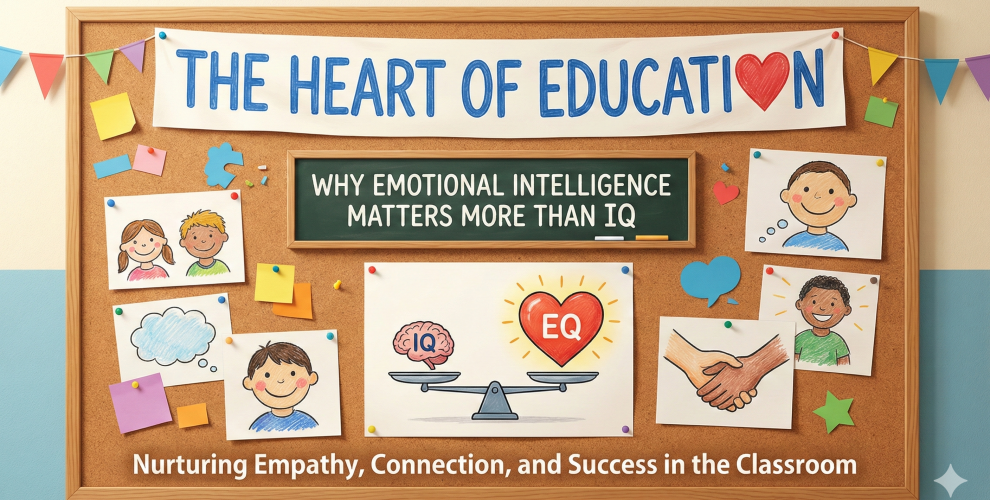
The Heart of Education: Why Emotional Intelligence Matters More Than IQ
Introduction: The Silent Crisis in Our Classrooms
A 14-year-old student sits in the back of the classroom, staring blankly at her textbook. She scored 92% on her last exam, but inside, she is drowning. Her parents are fighting. Her best friend stopped talking to her. She feels anxious all the time but doesn’t know why. She has never learned the words to name what she feels, let alone how to manage it.
She is academically successful. She is emotionally struggling. And no one notices.
This is not an isolated case. It is an epidemic.
Studies show that mental health issues among Indian students have increased by 40% in the last five years. Anxiety, depression, and stress-related disorders are now common in children as young as 10. Yet, schools continue to focus almost exclusively on academic achievement, treating emotional well-being as a side concern—something to address only when it becomes a crisis. This approach is failing our children.
Intelligence Quotient (IQ) measures cognitive ability. But research is clear: Emotional Intelligence (EQ)—the ability to understand, manage, and navigate emotions—is a better predictor of life success than IQ. Students with high EQ have better relationships, higher academic achievement, better mental health, and more successful careers.
At Mentor International School, a top CBSE school in Hadapsar, we reject the outdated idea that education is only about filling minds with knowledge. We believe education must also nurture hearts—teaching children to understand their emotions, empathize with others, and navigate the complex social and emotional landscape of being human.
In this comprehensive guide, we will explore what emotional intelligence is, why it matters more than ever, how it impacts every aspect of a child’s life, and how schools and parents can intentionally develop it.
Part 1: What is Emotional Intelligence? Understanding the Five Pillars
Emotional Intelligence (EQ) was popularized by psychologist Daniel Goleman in the 1990s. It refers to the ability to recognize, understand, and manage emotions—both your own and others’.
Goleman identified five core components:
Definition: The ability to recognize and understand your own emotions in real-time.
What it looks like:
- A child who can say, “I feel angry right now because my friend took my pencil without asking.”
- A teenager who recognizes, “I’m anxious about the exam, not because I didn’t study, but because I’m afraid of disappointing my parents.”
Why it matters:
You cannot manage what you cannot name. Self-awareness is the foundation of all emotional intelligence.
Definition: The ability to manage and control your emotions, rather than being controlled by them.
What it looks like:
- A child who feels angry but takes deep breaths instead of hitting.
- A teenager who feels disappointed about a bad grade but uses it as motivation to improve, rather than giving up.
Why it matters:
Life is full of frustrations and disappointments. Self-regulation is the difference between reacting impulsively and responding thoughtfully.
Definition: The inner drive to pursue goals for personal fulfillment, not just external rewards.
What it looks like:
- A child who practices piano because they love music, not just because parents force them.
- A teenager who studies because they are curious, not just to get marks.
Why it matters:
Intrinsic motivation is what sustains effort over time. External motivation (grades, praise) is fleeting. Internal motivation is enduring.
Definition: The ability to understand and share the feelings of others.
What it looks like:
- A child who notices their friend is sad and asks, “Are you okay?”
- A teenager who defends a classmate being bullied, even though it is socially risky.
Why it matters:
Empathy is the foundation of all healthy relationships. It prevents bullying, builds trust, and creates communities of care.
Definition: The ability to navigate social situations, communicate effectively, resolve conflicts, and build positive relationships.
What it looks like:
- A child who can share toys and take turns.
- A teenager who can disagree with a friend respectfully, without ending the friendship.
Why it matters:
Almost every aspect of life—school, work, family—requires social skills. Students who can collaborate, communicate, and resolve conflict have a massive advantage.
Part 2: The Research – Why EQ Predicts Success Better Than IQ
Students who participate in Social-Emotional Learning (SEL) programs show an 11 percentile increase in academic performance compared to students who don’t. This is not because SEL teaches math or science—it is because emotionally intelligent students:
- Manage stress better, so they focus more effectively
- Have better relationships with teachers, so they engage more
- Persist through challenges, so they learn more deeply
Students with high EQ have significantly lower rates of anxiety, depression, and behavioral problems. They have better coping mechanisms, more positive self-talk, and stronger support networks.
SEL programs reduce anxiety and stress by teaching emotional regulation and promoting a culture of openness about mental health.
A longitudinal study by the Carnegie Institute of Technology found that 85% of financial success is due to skills in human engineering—personality, communication, negotiation, and leadership. Only 15% is due to technical knowledge.
Employers consistently rank emotional intelligence as one of the most important skills they seek in employees.
People with high EQ have more satisfying relationships, stronger friendships, and better family dynamics. They navigate conflict more effectively and build deeper connections.
They also report higher life satisfaction and happiness—not because their lives are easier, but because they manage challenges more effectively.
Part 3: The Crisis – Why Indian Students Are Emotionally Struggling
Despite the clear importance of EQ, most Indian schools do not teach it. The result is a generation of students who are academically accomplished but emotionally fragile.
The Pressure Cooker Environment
Indian education is hyper-competitive. Students face immense pressure to score high marks, get into top colleges, and secure prestigious careers. This pressure creates:
- Chronic stress and anxiety: Always feeling like you are not good enough
- Fear of failure: One bad exam feels like the end of the world
- Social isolation: No time for friendships or emotional connection
The Stigma Around Mental Health
In many Indian families, talking about emotions is seen as weakness. Children learn to suppress feelings, not express them. Mental health struggles are hidden, not addressed.
The Government of India has recognized this crisis, implementing the District Mental Health Programme in 704 districts to provide counseling in schools and colleges, life skills training, and suicide prevention services.
When schools prioritize only academics, students learn that their worth is tied to performance. They become fragile—one failure shatters their identity.
Emotionally intelligent students, on the other hand, understand that failure is feedback, not identity. They bounce back.
Part 4: The Mentor International School Approach – Building Emotional Intelligence Intentionally
At Mentor International School, we integrate Social-Emotional Learning into every aspect of school life.
Morning Check-Ins:
Every day begins with an emotional check-in. Students identify how they are feeling using an emotions chart. Teachers notice patterns and provide support when needed.
Emotion Vocabulary Building:
Young children learn: happy, sad, angry, scared. Older students learn: frustrated, anxious, overwhelmed, disappointed, proud, grateful.
Rich emotional vocabulary allows for precise communication.
Mindfulness and Regulation:
Students practice deep breathing, progressive muscle relaxation, and guided visualization. These tools help manage stress in real-time.
Conflict Resolution Skills:
Instead of punishing conflicts, we use them as teaching moments. Students learn:
- How to express feelings without blaming (“I feel hurt when…” vs. “You always…”)
- How to listen to understand, not to respond
- How to find win-win solutions
Empathy Building:
Through literature, role-play, and community service, students practice seeing the world through others’ eyes.
In Literature:
We analyze characters’ emotions. “Why did the character make that choice? How were they feeling? Have you ever felt that way?”
In History:
We explore how emotions drive historical events. “What emotions fueled the independence movement? How did leaders manage fear?”
In Science:
We study the neuroscience of emotions. “What happens in your brain when you feel angry? How does stress affect the body?”
In Physical Education:
We teach sportsmanship and emotional regulation in competition. “How do you handle losing? How do you celebrate winning without arrogance?”
Every student has access to a trained school counselor. Counseling is not just for “problem students”—it is for everyone.
Individual Counseling:
Students can schedule confidential sessions to talk about stress, relationships, family issues, or anything bothering them.
Group Counseling:
Small groups address common challenges (test anxiety, social skills, grief, etc.).
Crisis Intervention:
When a student is in acute distress, immediate support is available.
Older students are trained as peer mentors. They:
- Provide emotional support to younger students
- Model healthy emotional expression
- Create a culture where asking for help is normalized, not stigmatized
We recognize that emotional intelligence must be reinforced at home.
Parent Workshops:
Monthly sessions teach parents how to:
- Validate emotions, not dismiss them (“I understand you are frustrated” vs. “Stop crying”)
- Model emotional regulation (children learn from watching parents manage stress)
- Create emotionally safe homes where feelings can be discussed
Family SEL Activities:
We send home activities (emotion charades, gratitude journals, family meetings) to practice EQ skills together.
Part 5: Age-Appropriate SEL – What to Teach When
Ages 5-7: Foundation (Naming Emotions)
Goal: Help children identify and name basic emotions.
Activities:
- Emotion faces chart (happy, sad, angry, scared)
- “How are you feeling today?” check-ins
- Books about emotions (“The Feelings Book,” “In My Heart”)
- Role-play scenarios (“What would you do if someone took your toy?”)
Expected Outcome:
By age 7, children can identify their emotions and express them in words (“I feel sad”) instead of behavior (crying without explanation).
Ages 8-10: Building Blocks (Understanding Emotions)
Goal: Help children understand why emotions happen and how to respond.
Activities:
- “Feelings thermometer” (rating intensity: a little angry vs. very angry)
- Identifying triggers (“I feel anxious before tests”)
- Breathing exercises and calm-down strategies
- Empathy exercises (“How do you think your friend felt when…?”)
Expected Outcome:
By age 10, children can explain why they feel certain ways and have basic strategies to calm themselves.
Ages 11-13: Complexity (Managing Emotions)
Goal: Help pre-teens manage complex emotions and navigate social challenges.
Activities:
- Journaling feelings
- Conflict resolution role-plays
- Growth mindset lessons (“Mistakes help me learn”)
- Peer mediation training
- Discussions about peer pressure and social dynamics
Expected Outcome:
By age 13, students can manage emotions without constant adult intervention. They can resolve peer conflicts independently and seek help when needed.
Ages 14-18: Mastery (Applying EQ to Life)
Goal: Help teens use emotional intelligence in relationships, decision-making, and future planning.
Activities:
- Leadership and team-building exercises
- Discussions about identity, purpose, and values
- Stress management for exams and college preparation
- Relationship skills (romantic, family, friendships)
- Mental health awareness and self-care
Expected Outcome:
By age 18, students have a strong sense of self, healthy relationships, and the tools to manage adult challenges.
Part 6: The Parent’s Role – Raising Emotionally Intelligent Children
Parents are the primary emotional educators. What you model and reinforce at home shapes your child’s EQ more than anything else.
Bad: “Stop crying. It is not a big deal.”
Good: “I see you are really upset. Tell me what happened.”
Validation teaches children that emotions are real and deserve attention.
Bad: “What’s wrong with you?”
Good: “It seems like you are feeling frustrated because your tower keeps falling down.”
Naming emotions helps children develop emotional vocabulary.
Bad: Parent yells when stressed.
Good: Parent says, “I’m feeling overwhelmed right now. I’m going to take a few deep breaths.”
Children learn by watching. If you regulate emotions, they will too.
4. Teach Problem-Solving, Not Rescuing
Bad: Parent solves every problem for the child.
Good: Parent asks, “What do you think you could do about this?”
Problem-solving builds resilience.
Make it clear that all emotions are okay to feel and express.
“In our family, we can talk about anything. If you are sad, angry, scared—you can tell me.”
6. Limit Screens, Maximize Connection
Face-to-face interaction develops empathy. Screen time does not.
Make dinners device-free. Have conversations. Notice emotions.
Part 7: Common Challenges and Solutions
“My child refuses to talk about feelings.”
Solution: Don’t force it. Create opportunities. Read books about emotions. Comment on characters’ feelings. Gradually, your child will open up.
“My child is overly emotional—they cry over everything.”
Solution: This is often a sign that they don’t have the tools to regulate. Teach coping strategies (breathing, journaling, physical activity). Validate the emotions while teaching management.
“My teenager is moody and distant.”
Solution: Adolescence is emotionally turbulent. Don’t take it personally. Keep communication open. Let them know you are there when they want to talk. Respect their privacy while staying engaged.
“I wasn’t raised to talk about emotions. How do I teach what I don’t know?”
Solution: You can learn together. Read books on EQ. Attend parent workshops. Model vulnerability: “I’m learning too. Let’s figure this out together.”
Part 8: Real Stories – Emotional Intelligence in Action
Story 1: The Anxious Student Who Found Her Voice
Meera was a Grade 7 student with debilitating test anxiety. She would vomit before exams and scored poorly despite studying.
The school counselor taught her:
- Breathing techniques
- Positive self-talk (“I am prepared. I can do this.”)
- Reframing failure (“One bad test does not define me.”)
Over six months, Meera’s anxiety decreased. Her performance improved. More importantly, she learned that she could manage her emotions—they didn’t have to control her.
Story 2: The Bully Who Became a Leader
Arjun was a Grade 5 bully. He hit peers, took their belongings, and was disruptive.
Instead of just punishing him, the school dug deeper. They discovered: Arjun’s father was emotionally abusive. Arjun was acting out pain.
Through counseling and SEL, Arjun learned:
- To name his anger
- To channel it through sports
- To ask for help when overwhelmed
By Grade 8, Arjun was a peer mediator, helping other students resolve conflicts. He transformed his pain into purpose.
Story 3: The Empathetic Leader
Priya was always empathetic. She noticed when peers were sad and checked on them.
Her teachers nurtured this strength. By Grade 10, Priya started a mental health awareness club at school. She organized workshops, created safe spaces for students to talk, and became a student counselor.
Priya’s emotional intelligence became her superpower—and her future career path.
Conclusion: The Heart of Education
We can no longer pretend that education is only about academics. The world is changing too fast. Information is available everywhere. What will distinguish successful humans in the 21st century is not what they know—it is how they manage themselves, relate to others, and navigate complexity.
Emotional intelligence is not a “soft skill.” It is a core competency.
At Mentor International School, we are committed to developing the whole child—mind, body, and heart.
We invite you to experience education that values emotional well-being as much as academic excellence.
Visit Mentor International School in Hadapsar. See classrooms where emotions are discussed openly. Meet counselors who support students through challenges. Watch students practicing empathy, conflict resolution, and self-awareness. Experience a school where success is measured not just by exam scores, but by the emotional health and character of our graduates.
Because the students who understand their hearts will be the leaders who change the world.
