

STEM Learning in Schools – Why It Matters | Redefining Education at the Top CBSE School in Hadapsar
If you were to walk into a classroom twenty years ago, you would likely see a familiar scene: rows of desks, a teacher at the blackboard, and students quietly taking notes. The primary goal was the transfer of information—facts, dates, and formulas to be memorized and reproduced during exams.
Fast forward to today, and the world outside the classroom has changed unrecognizable. We are living through the Fourth Industrial Revolution, an era defined by Artificial Intelligence, automation, biotechnology, and instant global connectivity. In this landscape, information is free and abundant; what matters now is what you can do with it.
This shift has birthed a new imperative in education: STEM Learning.
For parents in Pune’s bustling IT and industrial hubs like Hadapsar, the term “STEM” is likely familiar. But at Mentor International School, we believe it is more than just a buzzword. It is the engine of modern pedagogy. As a top CBSE school in Hadapsar, we are not just teaching children to survive in the future; we are teaching them to build it.
In this deep dive, we explore why STEM matters, how it shapes young minds, and how Mentor International School is pioneering this approach in Pune.
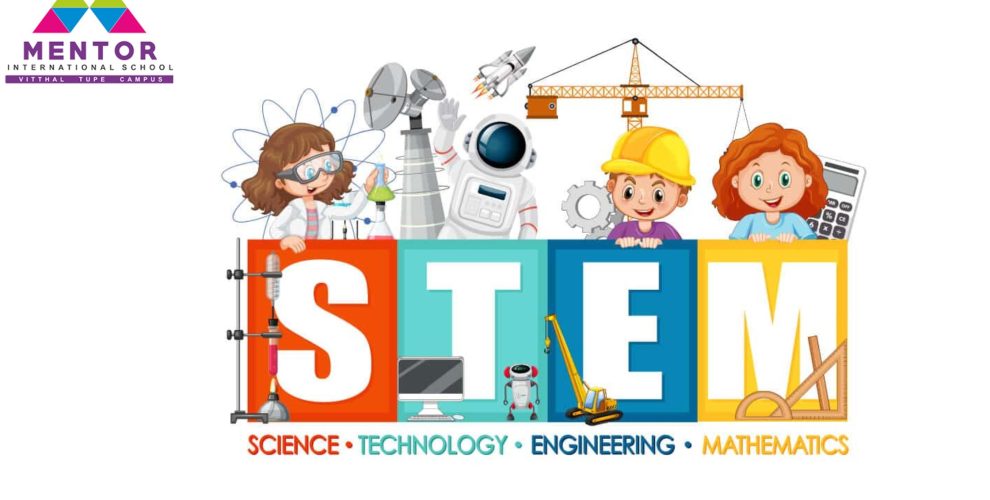
STEM stands for Science, Technology, Engineering, and Mathematics. However, viewing it as simply a collection of four separate subjects misses the point entirely. In a traditional curriculum, you might have Math at 9:00 AM and Biology at 10:00 AM, with no connection made between the two.
STEM is an interdisciplinary philosophy. It is based on the idea that these four disciplines are deeply interconnected in the real world. Architects don’t just use art; they use physics and geometry. Game developers don’t just write code; they use logic and narrative structures.
Effective STEM education removes the artificial barriers between subjects. It creates a learning environment where students apply science, technology, engineering, and mathematics in contexts that make connections between the classroom and the world around them.
The “Why”: The Critical Importance of STEM in 21st-Century Schools
Why is there such a global push for STEM? Is it just to create more software engineers? While career preparation is part of it, the benefits of STEM education go far deeper into cognitive development and life skills.
The World Economic Forum estimates that 65% of children entering primary school today will end up working in completely new job types that don’t yet exist. The days of lifelong careers in a single, repetitive role are fading. The future workforce will need to be agile, tech-literate, and capable of complex problem-solving. STEM education provides the foundational literacy for this new economy.
2. Developing Critical Thinkers
STEM learning is fundamentally inquiry-based. It encourages students to ask “Why is this happening?” rather than just “What is the answer?” Whether it is debugging a line of code or figuring out why a bridge structure collapsed during a physics experiment, students learn to analyze failures and iterate solutions. This builds Critical Thinking—the ability to objectively analyze information to form a judgment.
3. Fostering Innovation and Creativity
There is a myth that STEM is dry and mechanical. In reality, it is the playground of the imagination. Engineering is about designing solutions to human problems. Technology is about creating new ways to connect. At Mentor International School, we often emphasize STEAM (adding ‘Arts’), recognizing that the most successful engineers and scientists are those who can think creatively and design with empathy.
4. Building Resilience (The Growth Mindset)
In a traditional exam, a wrong answer is a failure. In a STEM lab, a wrong result is a discovery. When a student builds a robot that doesn’t walk, they haven’t failed; they have found one way that doesn’t work. They tweak the code, adjust the gears, and try again. This iterative process builds resilience and persistence—qualities that are essential for success in any walk of life.
The Local Context: Why Hadapsar Needs STEM
Hadapsar is not just a residential suburb; it is one of Pune’s most vital economic engines. Home to major tech parks like Magarpatta City and SP Infocity, as well as flourishing industrial zones, this area is a microcosm of the global tech economy.
Children growing up in Hadapsar see technology in action every day. They live in a community driven by innovation. Therefore, schools in this region have a responsibility to align their education with the ecosystem around them. As a top CBSE school in Hadapsar, Mentor International School bridges the gap between the academic world and the professional world that surrounds our students. We are grooming the next generation of innovators who will likely lead the very companies located in our backyard.
How Mentor International School Implements STEM
Many schools claim to offer STEM education, but true implementation requires infrastructure, trained faculty, and a visionary curriculum. At Mentor International School, we have invested heavily to ensure our STEM program is not just a supplement, but a core pillar of our academic identity.
1. The Robotics & Coding Advantage
Robotics is the perfect entry point for STEM because it makes abstract concepts tangible.
- Hands-on Engineering: Our students don’t just look at diagrams of gears and levers; they hold them. They understand mechanics by building structures that move.
- Logic & Coding: In our computer labs, students learn that a computer is not magic—it is a tool that follows instructions. Learning to code teaches Computational Thinking, breaking down large problems into small, logical steps (algorithms).
- The Mentor Approach: Our Robotics program is integrated into the school schedule. We provide kits and tools appropriate for different age groups, ensuring that a 1st grader creates simple mechanisms while older students tackle complex automation challenges.
2. State-of-the-Art Laboratories
You cannot learn to swim in a library, and you cannot learn science effectively from a textbook alone. Mentor International School boasts extensive laboratory infrastructure that meets and exceeds CBSE standards.
- The Sciences: Our Physics, Chemistry, and Biology labs are designed to be safe spaces for exploration. We encourage students to conduct experiments that verify the theories they learn in class.
- The Math Lab: Mathematics is often feared by students because it feels abstract. We utilize a dedicated Math Lab where mathematical concepts are taught using physical manipulatives, models, and real-world data. This transforms Math from “scary numbers” to “useful tools.”
One of the strengths of the Central Board of Secondary Education (CBSE) curriculum is its focus on continuous and comprehensive evaluation. We leverage this flexibility to integrate STEM projects into the standard syllabus.
- Project-Based Learning (PBL): Instead of ending a chapter with a test, we often end it with a project. A chapter on ‘Conservation of Resources’ might culminate in students designing a rainwater harvesting model for the school. This ensures deep retention of knowledge.
- Interdisciplinary Weeks: We organize science fairs and hackathons where students must use skills from multiple subjects to solve a problem statement.
Tools are useless without guidance. The “Mentor” in our name reflects our teaching philosophy. Our educators are not just lecturers; they are facilitators of curiosity. Our STEM faculty undergoes regular training to stay updated with the latest educational technologies and pedagogies. They know when to step in and help, and more importantly, when to step back and let a student struggle productively to find the solution.
Beyond the Circuit Board: The Soft Skills of STEM
One of the most surprising benefits we have observed at Mentor International School is the development of social and emotional skills through STEM.
- Collaboration: In the real world, no engineer builds a skyscraper alone. In our STEM labs, students work in teams. They learn to negotiate, delegate tasks, share ideas, and resolve conflicts. They learn that the best idea wins, regardless of who came up with it.
- Communication: A great invention is useless if you cannot explain it. We require students to present their projects, explaining their logic and design choices. This builds confidence and public speaking skills.
- Adaptability: Technology changes fast. The coding language popular today might be obsolete in five years. By focusing on the concepts of logic and engineering rather than just the tools, we teach students to be adaptable learners who are not afraid of change.
How Parents Can Support STEM at Home
Education is a partnership between the school and the home. As a parent, you don’t need to be a rocket scientist to support your child’s STEM journey.
- Encourage Curiosity: When your child asks “Why is the sky blue?” or “How does the microwave work?”, don’t just give the answer. Say, “I don’t know, let’s find out together.”
- ** Embrace the “Maker” Attitude:** encourage your children to fix broken toys, build with blocks, or cook (which is essentially chemistry!).
- Value the Process: Praise effort and strategy, not just intelligence. If they are struggling with a math problem, encourage them to try a different approach rather than giving up.
Conclusion: Preparing for a Limitless Future
The world is not slowing down. As Artificial Intelligence begins to automate routine tasks, the humans who will thrive are those who can offer what machines cannot: empathy, complex critical thinking, and creative innovation.
At Mentor International School, we are committed to producing this generation of thinkers. By combining the academic rigor of the CBSE curriculum with the forward-looking dynamism of STEM education, we provide a holistic environment where children can find their passion and hone their skills.
We are proud to be recognized as a top CBSE school in Hadapsar, but we are prouder of our students—the young scientists, engineers, artists, and leaders who walk our hallways every day.
Join us on this journey of discovery.
If you are looking for a school that prioritizes your child’s future readiness, we invite you to visit our campus. Walk through our Robotics lab, see the projects on our walls, and feel the energy of innovation that defines Mentor International School.
Admissions are open for the upcoming academic year. Contact Mentor International School, Hadapsar, Pune, to schedule your campus tour today.
