

7 Habits of Highly Successful Students (That Marksheets Can’t Show)
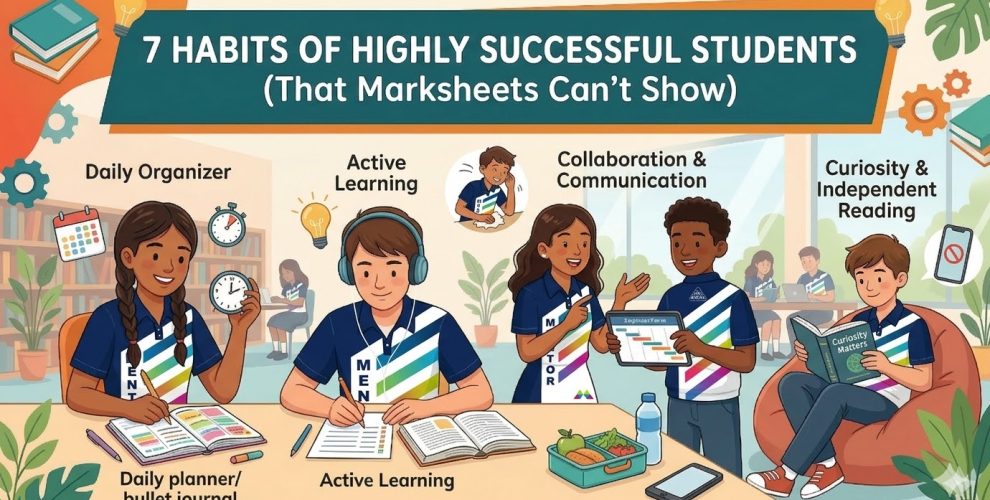
Introduction: Success Is More Than Just “Toppers”
Every class has a “topper”—the student whose name appears first on every result sheet.
But if you look closely, you’ll also notice other kinds of successful students:
- The one who explains concepts clearly to friends
- The one who never gives up, even after failing a test
- The one who participates in everything and still manages studies
- The one who is calm during exams while everyone else is panicking
These students may or may not be “rank 1”, but they carry habits that help them succeed not only in exams, but in life.
This blog is for you—the student who wants to improve, grow, and become the best version of yourself, not just a name on a mark sheet. We’ll explore 7 powerful habits any student can develop, and how Mentor International School, Hadapsar, helps you turn these habits into your everyday reality.
Habit 1: Owning Your Day (Time Management That Actually Works)
Many students are not failing because they are “weak” or “slow”. They are simply unplanned.
- Homework is delayed.
- Revision starts one night before the test.
- Projects are done in a rush.
- Sleep is sacrificed before exams.
Time doesn’t “disappear”—it gets spent in scrolling, chatting, random videos, and confusion about what to do next. When you don’t plan your day, your day controls you.
They don’t have more hours; they use their hours better.
Try this simple structure:
- Morning mini‑plan (5 minutes)
- List 3 important things for today:
- “Finish science diagrams”
- “Revise maths chapter 3”
- “Read English chapter 4”
- These are your non‑negotiables.
- List 3 important things for today:
- Study blocks, not endless sitting
- Use 25–30 minute focused blocks with 5–10 minute breaks.
- During a block: no phone, no unnecessary tabs, no TV.
- During a break: stretch, walk, breathe—don’t dive into social media.
- Night review (5 minutes)
- Tick what you finished.
- Ask, “What didn’t I do today? Why?”
- Move 1–2 key tasks to tomorrow’s list.
Suddenly, you feel more in control. Instead of saying “I didn’t get time,” you’ll know exactly how you used your time.
How Mentor International School Helps You Build This Habit
At Mentor International School, Hadapsar, time management isn’t left to chance.
- Structured timetable with breathing space
The school day is planned to balance core subjects, activities, and short breaks so your brain doesn’t feel overloaded. This rhythm teaches you how to manage energy as well as time. - Homework that respects your time
Teachers coordinate homework and tests so you don’t face three big submissions on the same day. This shows you what realistic planning looks like and prevents constant last‑minute chaos. - Study‑skills guidance, especially in higher classes
As you move towards board years, teachers and coordinators actively guide you on how to break down your syllabus, plan weekly revision, and avoid cramming. You don’t just learn subjects; you learn how to learn. - Projects with clear stages and deadlines
Larger projects are broken into stages—topic selection, research, rough draft, final presentation—so you experience what professional time management feels like.
Over time, you don’t just follow the school’s structure; you start building your own structure outside school too.
Habit 2: Learning, Not Just “Completing”
Many students focus on only one question: “Is the work done?”
- Notes are copied, but not understood.
- Homework is finished, but answers are memorised blindly.
- Question banks are solved, but patterns are crammed without concepts.
This creates a dangerous illusion: you feel busy, but not genuinely prepared.
They ask a different question: “Do I understand this?”
You can test yourself like this:
- After reading a concept, close the book and explain it in your own words.
- Try to teach the concept to an imaginary friend or your younger sibling.
- For every formula, ask: “Where is this used?” and “Can I at least reason why this works?”
If you can’t explain it, you haven’t truly learned it yet.
When you focus on understanding:
- Revision becomes faster, because you’re not re‑memorising from zero.
- You can answer twisted or application‑based questions.
- You feel confident in exams instead of depending entirely on luck.
How Mentor International School Helps You Build This Habit
Mentor International School’s teaching approach is designed around concept clarity, not just syllabus completion.
- Interactive, concept‑driven classes
Teachers frequently ask “why” and “how” questions, not only “what is the definition?” You are encouraged to think, not just repeat. - Use of real‑life examples and activities
Science concepts may be explained through simple experiments, maths through everyday situations, and social studies through discussions about current events. When you see how ideas work in real life, you remember them better. - Regular formative assessments
Short quizzes, oral tests, and class activities tell teachers whether you’ve understood the topic. If many students struggle, teachers reteach or give extra practice instead of just moving on. - Emphasis on understanding in feedback
When your notebooks or test papers are checked, teachers often point out why a step went wrong and how to fix it. This helps you see homework and tests as learning tools, not just judgement.
In this environment, it becomes natural for you to value genuine understanding over empty completion.
Habit 3: Asking Questions (Even If You’re Shy)
Many students stay silent even when they don’t understand something.
You might think:
- “What if others laugh?”
- “What if the teacher gets annoyed?”
- “What if it’s a silly doubt?”
The result: confusion builds up chapter after chapter. By the time exams come, the gap feels huge and scary.
They have one simple rule:
“If I don’t understand, I will ask.”
You can choose how to ask:
- Raise your hand during class and say, “I didn’t understand this step.”
- Talk to the teacher for 2–3 minutes after class.
- Write your doubt down and ask in the next period.
- Discuss with friends who’ve understood the topic.
You don’t look “stupid” when you ask questions. You look serious about learning. And very often, someone else had the same doubt but was afraid to speak.
How Mentor International School Helps You Build This Habit
The school culture at Mentor International School actively supports questioning.
- Safe, respectful classroom environment
Teachers consciously encourage questions and treat them with respect. When students see that doubts are welcomed, not mocked, they become more confident to speak up. - Think–pair–share activities
Many lessons include brief pair or group discussions before whole‑class answers. You get to clarify your doubts with classmates first, which is easier if you’re shy. - Dedicated doubt‑clearing sessions
Before exams or after complex topics, teachers often set aside time just for questions. This tells you clearly: “It’s okay not to know everything immediately. Asking is part of learning.” - Approachable teachers
The school promotes a warm teacher‑student relationship. You’ll often find it easy to approach teachers after class or during break for quick clarification.
Asking questions slowly becomes normal for you, not something to be scared of.
Habit 4: Building a Growth Mindset (From “I Can’t” to “I Can Learn”)
- “I’m just bad at maths.”
- “I can never remember dates.”
- “I’m not a science person.”
These are examples of a fixed mindset—the belief that your abilities are permanent and unchangeable.
A growth mindset says:
- “I find maths hard right now, but I can improve with practice and help.”
- “Remembering dates is tough; I need better techniques.”
- “Science feels confusing; I’ll break it into smaller parts.”
They change their inner language.
Whenever you catch yourself saying “I can’t do this”, add one word: “yet”.
- “I can’t solve this type of algebra problem yet.”
- “I can’t speak confidently in front of the class yet.”
That one word opens a door in your mind.
Practical ways to grow:
- Start with simpler problems and gradually take on harder ones.
- Ask for one more explanation, maybe in a different way or with a different example.
- Note small wins: “Last month I got 4/20 in this topic; now I got 12/20.”
Success is not magic; it is effort + strategy + time.
How Mentor International School Helps You Build This Habit
The school environment is designed to celebrate effort and improvement, not just final ranks.
- Teachers praise process, not only marks
You’ll often hear feedback like, “I like how you tried all the steps,” or “Good improvement from last time.” This motivates you to keep working instead of labelling yourself. - Opportunities to retry and improve
In many activities and assignments, you get chances to correct errors, redo parts, or improve on your previous performance. You learn that failure is a step, not the end. - Stories and activities that highlight persistence
In assemblies and life‑skills sessions, you hear stories of people who struggled before succeeding, helping you see that struggle is normal, not shameful. - Balanced view of results
While academic performance is valued, the school also appreciates growth in confidence, participation, and behaviour. You’re not defined by one exam.
This culture trains you to think, “I can get better,” which is one of the most powerful attitudes you can carry into adult life.
Habit 5: Balancing Study, Rest, and Play
Two extremes many students fall into:
- “All play, no study” – panic before exams, promises to change “from next term.”
- “All study, no rest” – burnout, frustration, and a loss of interest in learning.
Your brain needs a healthy mix of:
- Focused work
- Physical movement
- Relaxation and sleep
Without balance, even talented students struggle.
They think like athletes.
A serious athlete doesn’t just train; they also rest, eat well, and recover. That’s how they perform at their best.
You can follow a simple daily framework:
- Study: at least 1–2 hours of honest, focused work (more in higher classes).
- Movement: 30–60 minutes of physical activity—sports, walking, cycling, anything that moves your body.
- Rest: some free time for hobbies, music, reading, or just relaxing.
- Sleep: aim for a regular sleep routine; don’t make late‑night screen‑based study the norm.
How Mentor International School Helps You Build This Habit
The school doesn’t believe in “only books, nothing else.”
- Strong focus on sports and physical education
Regular sports periods and activities ensure you move, play, and learn teamwork. This isn’t a break from learning—it supports your brain and body. - Co‑curricular and creative opportunities
Art, music, dance, drama, and events like celebrations or exhibitions give you healthy outlets for stress and creativity. - Reasonable expectations around homework and tests
By avoiding excessive workload, especially in younger classes, the school protects your evenings from becoming endless study marathons. You learn that you can work hard and still have a life. - Attention to student wellbeing
Teachers and coordinators keep an eye on students who seem exhausted or overly stressed, and support is offered when needed. Your health is taken seriously.
In such an environment, you naturally learn that success includes both achievement and wellbeing.
Habit 6: Choosing Your Circle Wisely (Friends Who Lift You Up)
Your environment silently shapes you.
If you spend most of your time with:
- People who constantly complain about teachers and school
- Friends who think cheating is “smart” and honesty is “stupid”
- Classmates who mock anyone who tries hard
…you will eventually start absorbing those attitudes.
They don’t choose only “toppers” as friends, but they choose people who:
- Respect learning
- Don’t make fun of effort
- Are honest and cooperative
- Encourage them to do better
Ask yourself:
- “Do I feel more motivated or more negative after being with my friends?”
- “Do my friends support my goals or distract me from them?”
You don’t have to break friendships dramatically. Just spend more time with those who inspire you and less with those who pull you down.
How Mentor International School Helps You Build This Habit
The school culture plays a big role in the kind of friendships you form.
- Group activities and teamwork
Projects, sports, club activities, and events often require you to work in teams. You experience what good collaboration looks like and learn to appreciate different strengths. - Clear stance on bullying and disrespect
Rules and values are set against bullying, teasing, and humiliation. This makes it easier for you to be yourself and choose friends who treat you well. - Opportunities to lead and support
Through roles like class monitors, house captains, event leaders, or project heads, you get to practise leadership that is based on respect and cooperation—not bossiness. - Value‑based environment
Regular discussions on values like honesty, kindness, responsibility, and respect create a climate where positive behaviour is admired. This influences the kind of friend groups that form.
In such a setting, it becomes more natural to choose friends who match your better side, not your worst impulses.
Habit 7: Reflecting and Resetting (Learning From Wins and Mistakes)
Most students live exam to exam without pausing to ask:
- “What worked for me this time?”
- “What didn’t work?”
- “What will I do differently next time?”
So the same patterns repeat:
- Last‑minute revision
- Ignoring weak chapters
- Poor time management in the paper
After each test or exam, they spend 10–15 minutes reflecting.
Use this simple template in a notebook:
- What went well?
- “I revised earlier than last time.”
- “I didn’t panic when I saw a tough question.”
- “My handwriting was clearer.”
- What did not go well?
- “I spent too long on one question.”
- “I forgot to revise diagrams.”
- “I left some multiple‑choice questions for the end and ran out of time.”
- What will I change next time?
- “I’ll start with the questions I know best.”
- “I’ll revise diagrams 2 days before the exam.”
- “I’ll practise writing answers under a timer.”
This small reflection makes every exam a teacher, not just a result.
How Mentor International School Helps You Build This Habit
Reflection is built into the learning process at Mentor International School.
- Post‑exam review sessions
After tests, teachers don’t just announce marks; they often go through common mistakes, discuss better strategies, and show model approaches. You learn how to improve, not just what you scored. - Feedback‑oriented report cards
Reports and PTMs focus on strengths, areas to improve, and behaviour—not only numbers. This invites you and your parents to think in terms of growth, not labels. - Goal‑setting activities
At different points in the year, you may be encouraged to set personal goals—academic, behavioural, or co‑curricular—and review them later. This builds the habit of planning and self‑correction. - Teacher guidance beyond marks
Many teachers at Mentor take time to talk to students individually about how they are coping, what they want to improve, and how to do it. You don’t have to figure everything out alone.
With this kind of support, reflection becomes a natural part of your journey, not an extra burden.
Remedial sessions.
The students who need further clarity -application on invited are in concepts and concept-af for specially curated Remedial classes.
Bringing It All Together: Designing Your “New You” as a Student
These 7 habits are not about becoming a “perfect” student. They are about becoming a stronger, wiser, more independent version of yourself.
To recap, successful students:
- Own their day with better time management.
- Focus on learning, not just completing work.
- Ask questions when they don’t understand.
- Believe they can grow, even in difficult subjects.
- Balance study, rest, and play to protect their health.
- Choose friends wisely, building a positive circle.
- Reflect and reset after every test or experience.
Mentor International School, Hadapsar, is built to support you in all of this—with thoughtful teaching, a caring environment, and opportunities that shape both your mind and your character.
You don’t have to change everything in one day. Pick one habit to start:
- Maybe you’ll begin with a 3‑point daily plan.
- Or decide to ask just one doubt this week.
- Or join a club or activity that builds your confidence.
- Or reflect honestly on your last exam.
Start small. Stay consistent. Adjust as you learn.
Marks matter—but you matter more than your marks. The habits you build now will stay with you long after school uniforms and report cards are gone.
Which habit will you start working on today—and how can your school help you take that first step?
