

From Shy to Confident: A Student’s Guide to Building Self‑Confidence

Introduction: Confidence Is Not Just for “Special” People
Some students walk into a classroom as if they were born for the stage:
- They raise their hand without fear.
- They volunteer for competitions.
- They seem relaxed even when speaking in front of many people.
If you are not like that, you might secretly think:
- “I’m just a shy person.”
- “Confidence is not for me.”
- “Others are naturally bold; I’m not.”
Here’s the truth: confidence is a skill, not a magic gift. Just like maths or drawing, you can improve it with the right mindset and practice.
This blog is for students who want to stop hiding at the back and start believing in themselves—on stage, in class, with friends, and in exams.
Part 1: Understanding What Confidence Really Is (And What It Isn’t)
Many students misunderstand confidence. They think:
- Confidence means talking loudly all the time.
- Confidence means never feeling scared.
- Confidence means showing off.
That’s not true.
You can be:
- Soft‑spoken and confident.
- Introverted and confident.
- Nervous sometimes and still confident.
Confidence simply means:
- Believing you can handle situations.
- Knowing that even if things go wrong, you’ll be okay.
- Trusting your ability to learn, ask for help, and improve.
Think of confidence as an inner voice that says:
“I may not be perfect, but I can try.
If I fail, I can learn.
I don’t have to hide.”
You don’t need to become a different person. You need to become a braver version of yourself.
Part 2: Where Low Confidence Comes From
If you struggle with confidence, it’s not because something is “wrong” with you. There are usually clear reasons.
Maybe you:
- Forgot your lines in a school play once.
- Got laughed at when you gave a wrong answer.
- Were compared to siblings or toppers.
- Were told harsh words like “useless” or “dumb.”
These experiences hurt. Your brain remembers them and says: “Let’s avoid risk so we don’t feel that pain again.”
You might keep thinking:
- “She speaks so well; I can’t do that.”
- “He always scores more marks.”
- “They are so talented… what am I?”
The more you compare, the smaller you feel. You only see others’ strengths and your weaknesses. You forget that you also have talents and areas where you can grow.
You may worry:
- “What will they think if I make a mistake?”
- “Will they laugh if I mispronounce a word?”
- “Will people say I’m showing off?”
This fear of “log kya kahenge” (what will people say) keeps many students silent, even when they know the answer or have a great idea.
4. Negative Self‑Talk
Sometimes the worst critic is inside your own head.
You might tell yourself:
- “I’m stupid.”
- “I always mess up.”
- “No one takes me seriously.”
If you repeat these thoughts often, your confidence naturally goes down.
The good news? Just as these habits were learned, new, healthier habits can also be learned.
Part 3: The Power of Small Wins
You don’t build confidence by suddenly giving a speech to 1,000 people. You build it through small wins, step by step.
Small wins are actions that feel slightly uncomfortable but possible, such as:
- Answering one question in class.
- Introducing yourself to a new classmate.
- Sharing your opinion in a small group.
- Reading aloud a paragraph when the teacher asks.
Each small win whispers to your brain: “See? You survived. You can do more next time.”
How Small Wins Grow Big Confidence
Imagine your confidence like a muscle.
- If you never use it, it stays weak.
- If you suddenly try to lift something very heavy, you may hurt yourself.
- If you start with light weights and gradually increase them, you become stronger.
In the same way:
- Start with very small challenges.
- Repeat them until they feel normal.
- Then slowly choose slightly bigger challenges.
Over months, you will look back and realise: “I’m doing things now that I was too scared to even try earlier.”
Part 4: Practical Exercises to Build Confidence Every Week
Here are simple, practical things you can do. You can even pick one exercise per week.
Exercise 1: The “One Answer a Day” Rule
If you never speak in class, this is for you.
- Choose one period each day (for example, Science).
- Decide that you will answer just one question or share one point in that class.
- It doesn’t have to be perfect—just participate.
At first, your heart may beat fast. That’s okay. After a few days, it becomes easier. Gradually, speaking in class will feel normal.
Exercise 2: Stand Tall, Sit Tall
Your body language affects how you feel.
- Stand with your back straight, shoulders relaxed, and head up.
- When you sit, avoid curling up like a ball or hiding your face.
- Look up while walking instead of constantly staring at the ground or your phone.
You will be surprised: changing your posture can instantly make you feel more alert and confident.
Exercise 3: The Compliment Notebook
We often remember criticism and forget compliments. Change that.
- Keep a small notebook or note on your phone.
- Whenever someone appreciates you (“Nice answer!”, “Good drawing!”, “Thanks for helping”), write it down.
- Read this list whenever you feel low.
This reminds you that you’re more capable and valued than your negative thoughts say.
Exercise 4: Talk to Yourself Like a Friend
If a good friend was nervous, you wouldn’t say:
- “You’re useless.”
- “You’ll definitely fail.”
- “Don’t even try.”
You’d probably say:
- “It’s okay, you can do this.”
- “Even if it doesn’t go perfectly, I’m proud you tried.”
- “Everyone makes mistakes; it’s normal.”
Start talking to yourself in the same kind, encouraging way. Whenever your mind says something harsh, ask:
“Would I say this to a friend?”
If not, change it.
Part 5: Confidence in Class: From Silent to Seen
Classroom is the perfect training ground for confidence.
- “If I give a wrong answer, everyone will laugh.”
- “Others are faster; I’ll look slow.”
- “My English/Hindi is not perfect; people will judge my speaking.”
But remember:
- Many students are scared—some hide it better than others.
- Most classmates forget your mistakes quickly; you remember them longer than they do.
- Teachers usually appreciate effort more than perfection.
Step‑by‑Step Plan
- Start in small groups
- During pair or group activities, share at least one idea.
- It’s less scary than talking to the whole class.
- Sit a little more forward
- If you always sit at the back, slowly start moving to the middle rows.
- Not necessarily first bench—but somewhere you can see and be seen.
- Ask doubts
- Start with, “Ma’am, I didn’t understand this step. Can you repeat it once?”
- You’ll notice: nothing terrible happens.
- Volunteer occasionally
- For reading a paragraph
- For writing on the board
- For helping distribute notebooks
These small acts slowly change how both you and others see you.
Part 6: Confidence on Stage: From “No Chance” to “I’ll Try”
Many students say, “Stage is not for me.” But stage is like a gym for your confidence—scary at first, powerful later.
On stage, you feel:
- Everyone is watching you.
- Every small mistake is huge.
- You must be perfect.
The truth:
- People are usually more focused on the general event than your small errors.
- Short pauses, mispronunciations, or minor stumbles are normal.
- Even experienced speakers feel nervous before going on stage.
- Begin with tiny roles
- Saying a line in a skit
- Announcing one item in the assembly
- Holding a placard or prop in a performance
- Practise out loud
- Stand in front of a mirror and say your lines.
- Record your voice and listen.
- Practise in front of a trusted friend or family member.
- Accept nervousness
- Don’t wait for fear to vanish; act with fear.
- Tell yourself, “Nervous means I care, not that I can’t do it.”
- Focus on the message, not on yourself
- Think, “I’m here to share a story/idea,” rather than “Everyone is judging me.”
Every time you survive a small stage experience, your confidence level jumps up a bit.
Part 7: Confidence with Friends and Social Situations
Confidence is not only about academics and stage. It also affects friendships, group work, and social life.
You may:
- Find it hard to start conversations.
- Worry about saying something “awkward”.
- Feel like your friends ignore or talk over you.
- Avoid group activities because you feel “out of place.”
- Learn basic conversation starters
- “How was your weekend?”
- “Did you understand today’s maths chapter?”
- “Which sports/video games/series do you like?”
- Listen more, then respond
- Good communication is not only talking.
- Show interest when others speak; then share your thoughts.
- Set boundaries with rude people
- You don’t have to be close friends with someone who constantly insults or mocks you.
- Be polite but keep some distance.
- Find people with similar interests
- Join clubs, activities, or groups based on things you enjoy.
- It’s easier to talk when you already share a topic.
Remember: you don’t need 50 friends. Even 2–3 genuine, respectful friends are enough to feel supported.
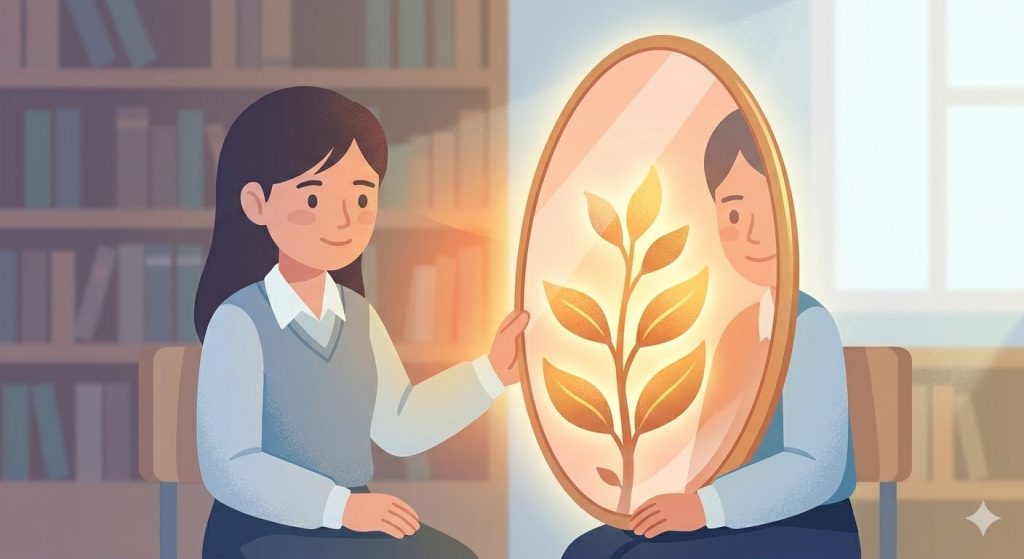
Part 8: Using Mistakes as Confidence Fuel (Not Confidence Killers)
Everyone makes mistakes—even toppers, even teachers, even adults.
The difference is:
- Some people let mistakes break their confidence.
- Others use mistakes to build confidence.
How to Turn a Mistake into Growth
- Admit it calmly
- “Yes, I got that wrong.”
- “I forgot my lines for a moment.”
- “I misread the question.”
- Ask: What can I learn?
- “Next time I’ll read the full question twice.”
- “I’ll practise my lines a few more times.”
- “I’ll revise this chapter earlier.”
- Move on
- Don’t keep replaying the moment in your head a thousand times.
- Others have already forgotten; you can let it go too.
Each time you recover from a mistake, your brain realises: “I can handle failure and still be okay.” That’s real confidence.
Part 9: A 21‑Day Confidence Challenge
Confidence grows with consistent action. Try this 21‑day challenge (you can even print it or write it in your notebook).
Goal: Get used to using your voice.
- Day 1: Answer one question in class.
- Day 2: Ask one doubt or clarification.
- Day 3: Talk to one classmate you don’t usually talk to.
- Day 4: Read aloud when a teacher asks for a volunteer.
- Day 5: Share one opinion in a group discussion.
- Day 6: Practise speaking 2 minutes in front of a mirror.
- Day 7: Write about what felt hardest and what went well.
Goal: Improve body language and self‑talk.
- Day 8: Walk into school with a straight back and head up.
- Day 9: Maintain eye contact for 2–3 seconds when talking to someone.
- Day 10: Replace one negative thought with a kinder one.
- Day 11: Sit in the middle rows instead of hiding at the very back.
- Day 12: Write down 5 things you like about yourself (skills, qualities, efforts).
- Day 13: Accept one compliment instead of rejecting it.
- Day 14: Review your progress so far.
Goal: Step slightly out of your comfort zone.
- Day 15: Volunteer for a small responsibility in class or at home.
- Day 16: Join or try an activity/club you’ve been curious about.
- Day 17: Share an idea in a planning meeting or group project.
- Day 18: Practise a short speech (even if you don’t have to give it yet).
- Day 19: Help someone else who seems shy or left out.
- Day 20: Talk to a teacher you respect about something other than marks.
- Day 21: Celebrate yourself—write down all the small brave things you did.
You don’t need to complete this challenge perfectly. Even if you do 50–70% of it, you’ll feel the change.
Conclusion: You Don’t Have to Be Loud to Be Strong
Confidence is not about shouting the loudest, acting “cool”, or becoming someone completely different.
It is about:
- Knowing you have value.
- Believing you can learn and improve.
- Daring to try, even when you feel scared.
- Standing back up when things go wrong.
Right now, you might see yourself as “the shy one” or “the quiet one”. That’s okay. You don’t have to erase that part of you. You just have to add another side:
The side that says:
“I may be quiet, but my ideas matter.”
“I may be nervous, but I’ll still try.”
“I may make mistakes, but I won’t stop growing.”
Confidence is not a destination you suddenly reach. It’s a road you walk every day with small, brave steps.
How Mentor International School, Hadapsar, Helps Students Build Real Confidence
Confidence grows fastest in a school environment that is safe, supportive, and full of structured opportunities to try, fail, improve, and shine. Mentor International School, Hadapsar, works on all these fronts so that even naturally shy students slowly discover their voice.
1. Supportive Classroom Culture (Safe to Make Mistakes)
At Mentor International School:
- Teachers encourage questions and treat doubts with respect instead of irritation, so students are not scared to speak up even if they are unsure.
- Wrong answers are used as learning opportunities—teachers often say things like, “Good try, let’s see where it went wrong,” instead of embarrassing the student.
- Group work and pair activities are used frequently, letting quieter students practise talking in smaller, safer settings before speaking in front of the whole class.
This kind of environment tells students: “You don’t have to be perfect to participate. You just have to try.”
2. Stage Opportunities for Every Child (Not Just the “Bold” Ones)
In many schools, only the most confident children get stage time. Mentor International School tries to ensure everyone gets a chance.
- Class assemblies, festivals, and special days are designed so multiple students can take small roles—anchoring, reading a thought for the day, performing a short skit, or presenting a project.
- Teachers gently encourage quieter students to take on tiny roles first (a line, a movement, a gesture), slowly increasing their participation as they become more comfortable.
- Events like debates, elocutions, story‑telling, and show‑and‑tell are introduced in age‑appropriate ways, starting from simple, low‑pressure formats in the junior classes.
Over time, students who once refused to go on stage often find themselves volunteering for bigger responsibilities.
3. Life‑Skills and Value‑Education Sessions
Mentor International School doesn’t leave confidence to chance; it is included as part of students’ life‑skills development.
- Sessions and activities focus on topics like self‑belief, positive self‑talk, handling failure, peer pressure, and communication skills.
- Through stories, role‑plays, games, and discussions, students learn that everyone feels nervous sometimes—and that courage means acting even with fear.
- Teachers discuss real‑life examples of people who struggled before succeeding, so students understand that confidence and success are usually built, not born.
These sessions give language and structure to what many students feel but don’t know how to express.
4. Encouraging Effort and Improvement, Not Just “Toppers”
A key reason many students lose confidence is constant comparison. Mentor International School takes a broader, healthier view of achievement.
- Teachers and school leaders publicly appreciate not only the top rankers, but also students who show improvement, consistency, teamwork, creativity, helpfulness, or courage (for example, attempting something new on stage).
- Report cards and feedback to parents often mention strengths and progress in behaviour, participation, and attitude, not just marks.
- During PTMs and interactions, parents are encouraged to notice and support their child’s efforts and growing confidence, instead of focusing only on relative positions in class.
When students see that their effort and growth are noticed, they feel safer to take risks and try new things.
5. Clubs, Activities, and Sports That Build Confidence
Confidence doesn’t grow only in the classroom; it also grows on the playground, in art rooms, and during activities.
At Mentor International School:
- Co‑curricular clubs (arts, music, drama, science, reading, etc.) give students different ways to express themselves beyond academics. A child who is quiet in class might come alive in theatre, music, or sports.
- Sports and team games teach students to handle wins and losses, to communicate with teammates, and to take responsibility for their role—key ingredients of confidence.
- Inter‑house or inter‑class competitions are designed to be inclusive, giving more children the chance to participate rather than repeating the same small group every time.
When students experience success and growth in multiple areas, they start seeing themselves as capable people, not just “good” or “bad” in one subject.
6. Teacher–Student Relationships that Build Trust
True confidence grows when students know there are adults who believe in them.
- Teachers at Mentor International School are encouraged to know their students as individuals—strengths, fears, interests, and goals.
- Many students find it easy to approach teachers for guidance not only about academics, but also about stage fear, friendship issues, and self‑doubt.
- A simple “I know you can do this, try once, I’m here” from a trusted teacher before a presentation or exam often becomes a turning point for a child.
This kind of trust slowly becomes students’ inner voice: “If my teacher believes I can do it, maybe I really can.”
7. Involving Parents in the Confidence Journey
Confidence is strongest when school and home work together.
Mentor International School:
- Communicates with parents about the importance of not comparing children harshly with others and of appreciating effort, not just perfect outcomes.
- Shares students’ small achievements—like speaking up more, taking a new role, showing leadership in a group—so parents can celebrate these at home.
- Encourages parents to give children opportunities to make small decisions, handle responsibilities, and speak for themselves in age‑appropriate ways.
When students get the same message at home and school—“You can learn, you can try, and we are with you”—their confidence has a solid base.
